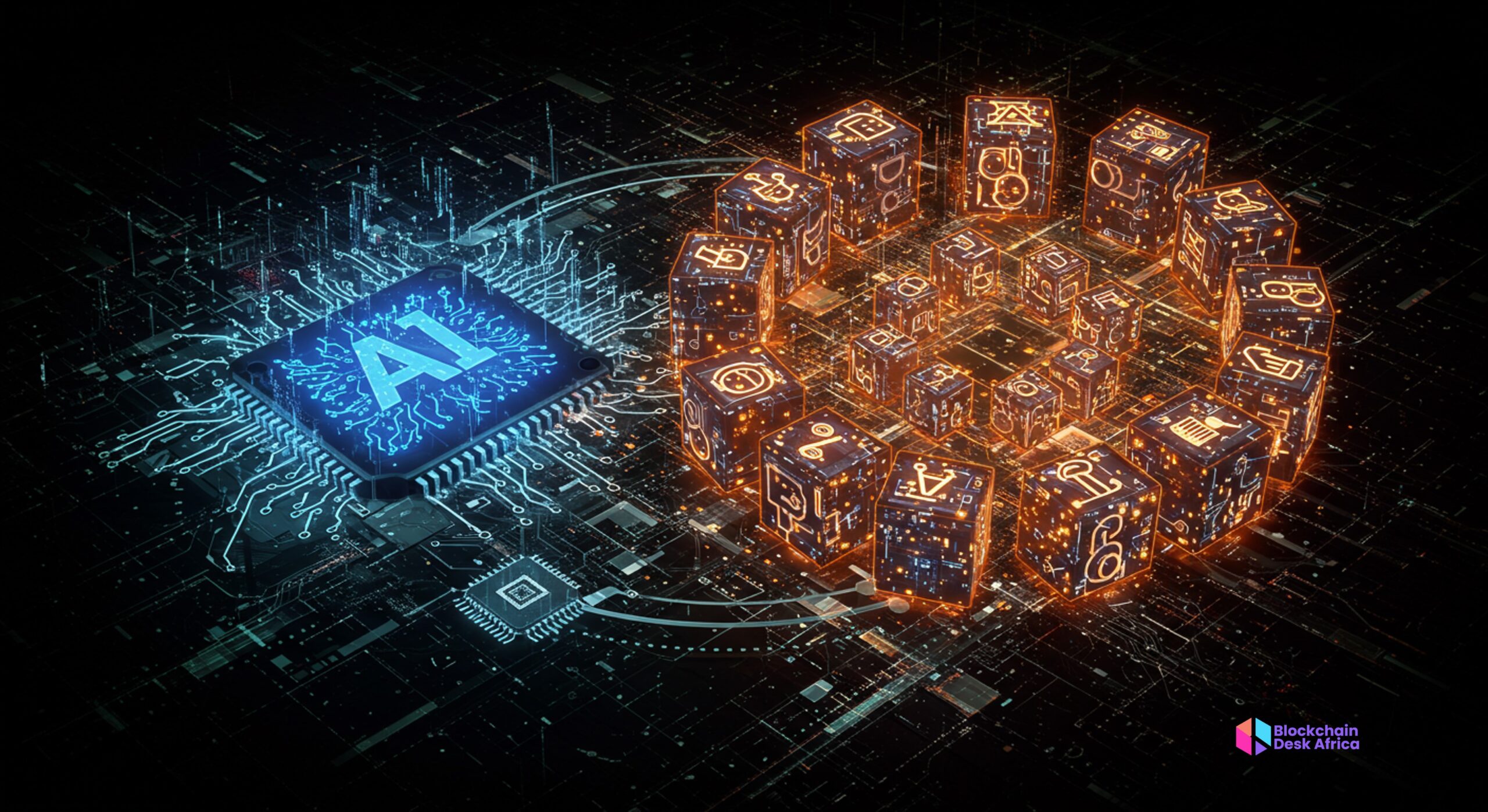
For years, artificial intelligence (AI) and blockchain developed along separate tracks. AI was focused on data, automation, and machine learning breakthroughs, while blockchain was busy building the foundations of decentralized finance and digital ownership. Around 2017, the first serious attempts to bring them together appeared, with projects like SingularityNET and Ocean Protocol experimenting with AI models powered by blockchain infrastructure. Since then, the idea of combining these two technologies has steadily gained momentum.
In 2025, that combination is no longer theoretical. We are seeing real products and platforms that put AI on blockchains, decentralised marketplaces for AI services, AI-enhanced DeFi lending, supply chain systems powered by blockchain with predictive AI, and even healthcare pilots where sensitive data is secured on-chain but analyzed by AI models.
This combination has made 2025 a defining year. Projects like Fetchai, Ocean Protocol, and SingularityNET are gaining traction, while traditional finance, enterprises, and regulators are watching closely. The promise is huge, but so are the questions: who owns the data, who takes responsibility when AI makes mistakes, and how much control should regulators have?
Why AI and blockchain matter together
AI needs large amounts of reliable data, but access and ownership of that data are often restricted. Blockchain can solve this by creating secure, transparent data-sharing environments where contributors are rewarded fairly.
On the other hand, blockchain systems sometimes suffer from inefficiency, slow speeds, heavy computations, or rigid automation through smart contracts. AI can help optimize these systems, making them more responsive and user-friendly
Together, they promise:
- Smarter finance – automated trading, fraud detection, decentralized lending.
- Healthcare breakthroughs – secure patient data sharing with AI diagnostics.
- Global commerce – supply chains where every step is traceable and optimized by machine learning.
- New governance models – decentralized organizations that use AI to manage decision-making more effectively.
Major developments in 2025
Several developments show how far AI and blockchain integration have come:
Smarter contracts and AI-powered DeFi
Traditional smart contracts are rigid; they execute only what the code says. But in 2025, AI is making them adaptive. DeFi projects like Aave and MakerDAO are experimenting with AI systems that predict risks, adjust lending rates, and flag anomalies in real time. Insurance platforms such as Etherisc are piloting contracts that trigger payouts automatically when AI verifies events like weather disasters or supply chain delays.
This brings flexibility and efficiency but raises new concerns. If an AI misjudges a risk or fails to trigger a contract, who is accountable: the developer, the AI, or the network?
Security, fraud detection, and compliance
Fraud is one of blockchain’s oldest problems. In 2025, AI is helping tackle it by spotting suspicious patterns across millions of transactions. Companies like Chainalysis and Elliptic are integrating AI-driven analytics to detect scams, hacks, and laundering schemes more accurately. Regulators are also adopting these tools to enforce compliance without slowing down innovation.
Decentralized AI marketplaces
One of the most exciting frontiers is decentralising AI itself. Instead of leaving AI development to a few big tech firms, projects are creating open platforms where anyone can contribute data, train models, and earn rewards.
- SingularityNET lets developers upload AI services and get paid in tokens.
- Ocean Protocol allows data owners to sell or share their data securely while keeping control.
- Fetch.ai builds autonomous AI “agents” that perform decentralized tasks like ride-hailing, supply management, or energy trading.
These platforms aim to democratize AI, but challenges remain , especially around data quality, incentives, and preventing misuse.
Scaling blockchain with AI
Blockchain networks often struggle with congestion, high fees, and energy use. AI is being used to predict traffic, adjust gas fees dynamically, and optimize consensus mechanisms. Ethereum rollup solutions and Cosmos ecosystems are exploring AI-driven optimization to make transactions cheaper and faster.
User experience: simpler, safer, smarter
Blockchain adoption has always suffered from complexity. In 2025, AI assistants will make wallets and apps easier to use. Platforms like Safe (formerly Gnosis Safe) and Argent are exploring AI-driven tools for account recovery, transaction guidance, and gas fee management.
This brings convenience but raises another trade-off: if AI automates too much, users may lose control, and blockchain risks sliding back toward centralization.
Green technology and sustainability
Both AI and blockchain consume significant energy. In 2025, sustainability is front and center. Projects are using AI to forecast energy demand, improve efficiency, and support cleaner consensus methods. Blockchains with proof-of-stake and AI-optimized energy tracking are publishing sustainability reports to meet expectations.
AI and blockchain in finance
From AI-powered risk models in DeFi to stablecoins supervised by AI monitoring systems, finance is the biggest testing ground for this combination. Tokenized assets are becoming more common, with AI used to manage liquidity and pricing. In 2025, banks and fintechs are trialing blockchain rails for settlements while integrating AI for compliance and fraud detection.
Identity, privacy, and digital rights
Decentralized identity (DID) systems are emerging as a bridge between blockchain and AI. AI models can verify identities, detect fraudulent activity, and streamline KYC checks, while blockchain secures user credentials. This has major implications for cross-border payments, healthcare, and digital governance.
Healthcare and AI-data sharing
In healthcare, the combination of AI and blockchain is especially promising. Blockchain secures sensitive patient data while AI analyzes it to detect diseases, track treatments, and personalize medicine. Trials are already happening in Europe and North America, and African startups are beginning to explore similar models for medical supply chains and remote care.
Opportunities and challenges
The opportunities are huge, but so are the challenges.
Opportunities:
- More efficient financial systems and cross-border payments.
- Fairer data economies, where individuals can monetize their data.
- Better transparency in industries like supply chain, healthcare, and government services.
Challenges:
- Regulation: Governments are still figuring out how to regulate AI models and blockchain networks without stifling innovation.
- Energy use: Some blockchains remain energy-intensive, raising environmental questions.
- Centralization risk: Big banks or corporations may dominate the infrastructure, pushing out smaller innovators.
- Bias and trust: AI models are only as good as the data they’re trained on, and blockchain doesn’t automatically fix that.
What to watch in the months ahead
Looking beyond early 2025, several developments will shape the direction of AI and blockchain:
- Regulatory rollouts – The EU’s AI Act enforcement is expected to tighten rules on AI use. Meanwhile, the U.S. is working on clearer guidelines for digital assets, and countries like Nigeria, Kenya, and South Africa are piloting digital ID and payment projects.
- Enterprise pilots – Banks are testing tokenized assets combined with AI-driven compliance systems. Healthcare providers are exploring AI + blockchain for patient data sharing.
- Startups and funding – Venture capital is flowing into AI-blockchain hybrids, particularly in data marketplaces, DeFi, and decentralized infrastructure.
- Technology upgrades – Ethereum scaling solutions and other L2s are integrating AI-powered automation tools, which could bring smarter on-chain experiences.
- Global coordination – How countries align their standards will determine if these technologies scale smoothly across borders or remain fragmented.
These next moves will tell us whether AI and blockchain remain a niche or become the backbone of a new digital economy.
Final thought
AI and blockchain are no longer buzzwords. In 2025, they’re working together to build more open, intelligent, and secure digital systems. The potential is high, but it won’t come without trade-offs ,compliance costs, ethical risks, and the danger of centralization. Still, the direction is clear: the combination of AI and blockchain is shaping finance, healthcare, supply chains, and governance in ways that could define the decade.