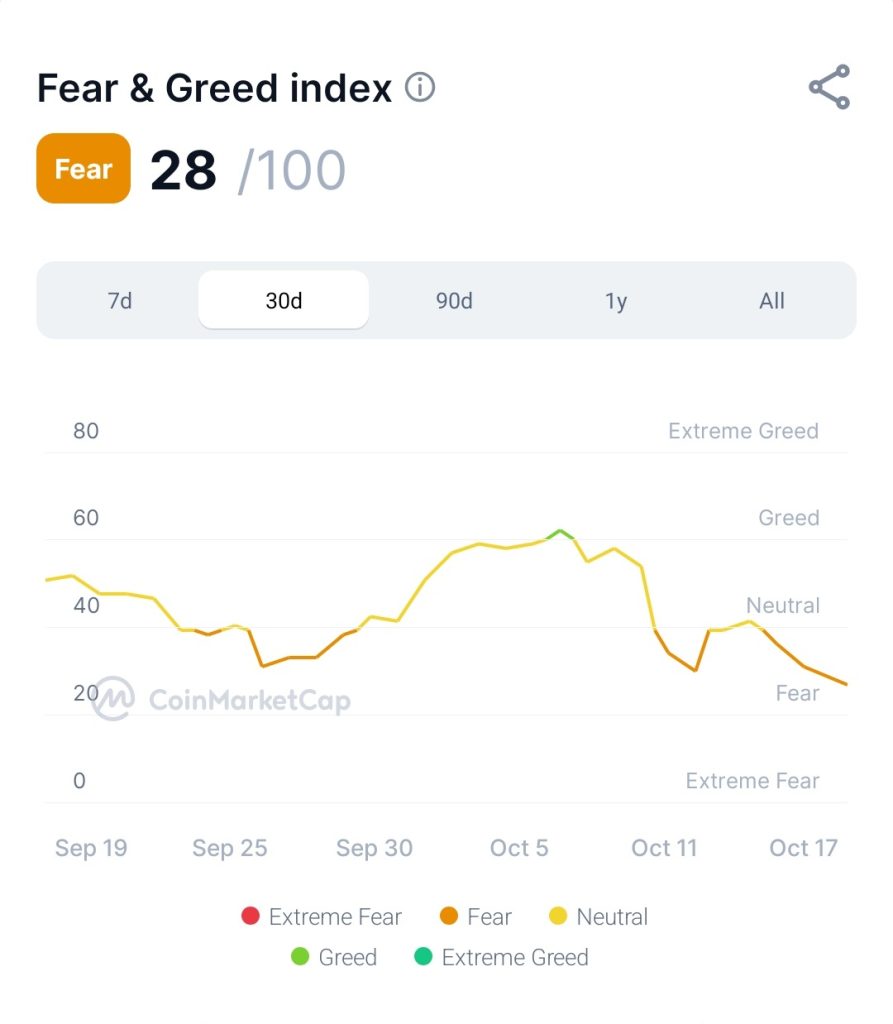
The Crypto Fear & Greed Index, a popular barometer of market sentiment, has plunged to 28, its lowest level since April 2025. The drop highlights growing uncertainty among traders as crypto prices tumble alongside traditional financial markets.
According to data from CoinMarketCap, Bitcoin plunged ~6.1% to ~$104,713, while Ethereum dropped ~7.8% and Solana tumbled ~9.4% in a single session, according to Barron’s. Meanwhile, several days earlier Bitcoin reached a low of $104,782.88, more than 14% down from recent highs near $122,574.
The collapse continues since the $19 billion liquidation event, one of the largest in crypto history. Margin calls triggered widespread selling, particularly among long positions, amplifying the downward spiral.
Why Fear Is Rising
The Fear & Greed Index, created by Alternative.me, aggregates data such as volatility, trading volume, social media sentiment, dominance, and Google Trends. Scores range from 0 (“Extreme Fear”) to 100 (“Extreme Greed”). The current reading of 28 indicates that investors are increasingly risk-averse, a mood often associated with market bottoms in past cycles.
Recent CryptoQuant and Coinglass data show more than $500 million in liquidations within 24 hours, with a majority coming from overleveraged long positions. The event triggered sharp sell-offs and increased short-term volatility, further eroding trader confidence.
This decline doesn’t exist in isolation. Global markets are showing similar nervousness, with the traditional CNN Fear & Greed Index also dipping into “fear” territory. Rising bond yields and uncertainty surrounding U.S. Federal Reserve rate policy have caused risk assets, from tech stocks to cryptocurrencies, to retrace recent gains.
Yet, despite the broader caution, on-chain metrics tell a more nuanced story. Whale wallets (addresses holding 1,000 BTC or more) have shown a slow uptick in accumulation over the past week. This behaviour, according to data from IntoTheBlock, often signals that long-term investors view market dips as discounted entry points.
What Comes Next
Historically, when the index falls below 30, Bitcoin tends to stage a rebound within weeks or months. However, analysts warn that sentiment alone is not a timing tool. The combination of lower liquidity, institutional repositioning, and geopolitical tension could extend market consolidation through October.
Still, seasoned traders see opportunity in fear. As one analyst put it: “Extreme fear doesn’t mark the end of crypto cycles it usually marks the beginning of the next one.”
For now, the market’s mood remains cautious, but if history is any guide, moments like these often precede the next wave of opportunity.
Read also: Kimi AI: The Chinese Challenger Quietly Rising to Take on OpenAI