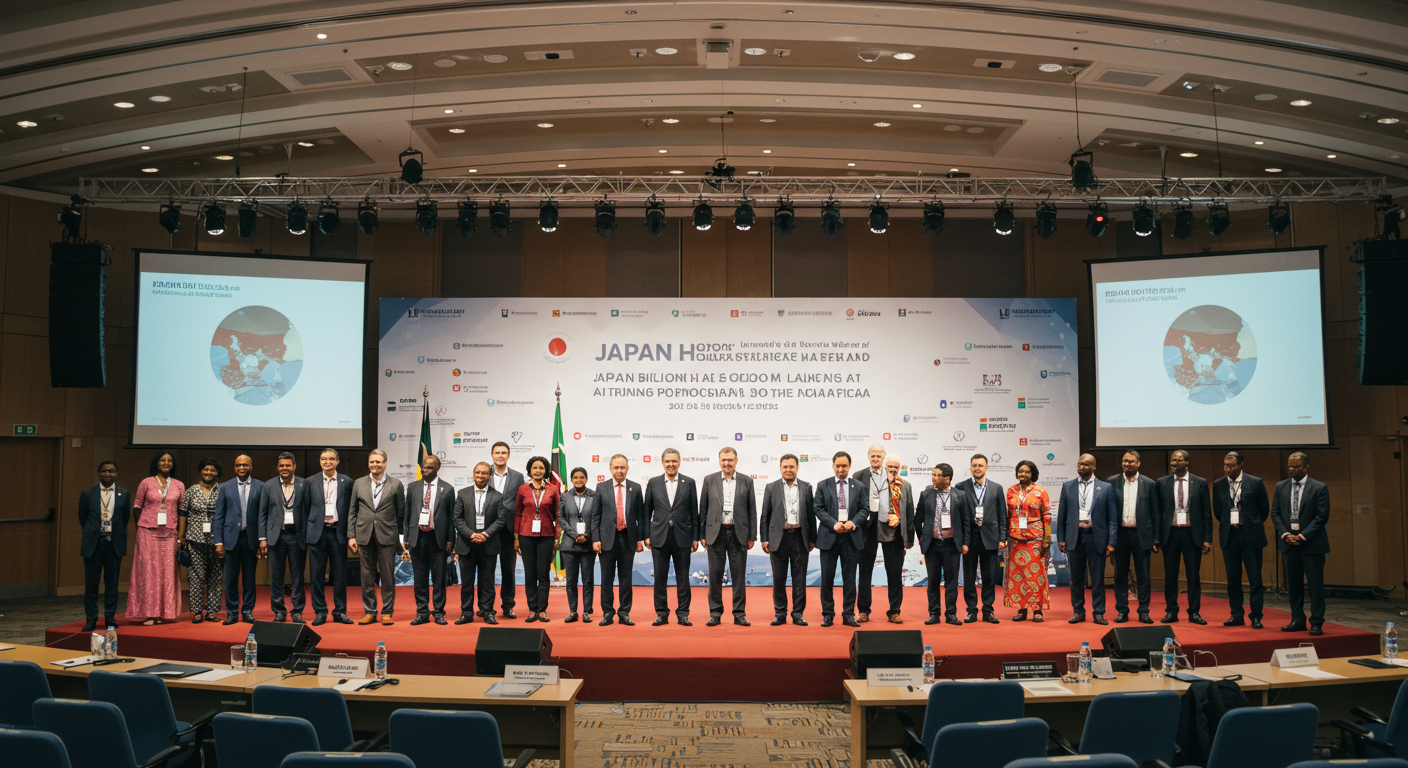
Japan has announced a plan to train 30,000 African professionals in artificial intelligence (AI) as part of its broader ambition to strengthen diplomatic and economic ties with the continent. The announcement was made during the 9th Tokyo International Conference on African Development (TICAD-9) held in August 2025, where Japan also pledged $5.5 billion in development loans and digital infrastructure support to deepen its partnership with Africa.
The initiative signals Japan’s intention to take a more active role in shaping Africa’s technological future while expanding its presence beyond traditional trade and aid relationships. Tokyo’s move comes at a time when global powers are racing to secure strategic influence on the continent, and Japan is choosing a path built on technology transfer, skills development, and sustainable innovation.
Why Japan Is Turning Its Focus to Africa
Japan’s growing focus on Africa is both strategic and forward-looking, driven by mutual opportunity and shared development goals. The program will initially engage Kenya, Nigeria, Ghana, Egypt, and South Africa, with plans to expand to other nations as part of a multi-year partnership. These countries were selected because of their strong digital ecosystems, growing developer communities, and readiness to integrate AI technologies across various sectors.
Africa’s demographic advantage is another powerful motivation. The continent, home to more than 1.4 billion people, boasts over 60% under the age of 25, making it the youngest region globally. Japan sees this as a unique opportunity to help cultivate the next generation of global AI innovators. By contrast, Japan’s own population is aging rapidly, with a shrinking workforce and slowing domestic productivity. Investing in African human capital gives Japan a long-term advantage , connecting its technological expertise with Africa’s youthful talent pool.
Beyond demographics, Tokyo’s renewed interest in Africa also reflects an intent to balance global influence. As China, the United States, and the European Union intensify their engagement on the continent, Japan is carving out a distinctive role rooted in education, ethics, and innovation rather than competition or dependency.
Building Africa’s Next Generation of AI Experts
The AI training initiative will be carried out through collaborations between Japanese universities and African academic institutions. Among the partners expected to take the lead are the University of Tokyo’s Matsuo Lab, known for its work in machine learning, and major African universities such as the University of Nairobi (Kenya), University of Lagos (Nigeria), and Kwame Nkrumah University of Science and Technology (Ghana).
Training programs will focus on applied AI and data-driven solutions, empowering participants to address pressing local challenges such as precision farming, healthcare analytics, smart energy systems, and supply-chain management. The approach emphasizes real-world innovation over theoretical research, ensuring graduates can immediately apply their skills in both public and private sectors.
Japan will also establish regional AI innovation hubs in Nairobi, Accra, Lagos, and Cairo, where program graduates and researchers can collaborate with Japanese tech firms on joint projects. These centers will serve as incubators for digital startups and research development, encouraging cross-continental innovation and knowledge sharing.
This partnership extends beyond training , it reflects Japan’s long-term digital diplomacy strategy, where technology becomes a bridge for stronger political and economic relationships. Tokyo’s involvement is expected to open new avenues for investment in Africa’s digital infrastructure while also creating opportunities for African startups to access Japanese technology and mentorship.
A Strategic Reawakening of Japan–Africa Relations
The $5.5 billion funding package attached to this initiative will be directed not only toward human capital development but also toward building the infrastructure that will enable digital transformation. Japan is working alongside the African Development Bank (AfDB) to structure the financing in a way that supports economic growth while avoiding new debt traps. A portion of the funds will be allocated to supporting broadband connectivity, energy access, and digital infrastructure ,all critical elements for implementing AI systems effectively across the continent.
Japan’s renewed engagement with Africa is driven by both strategic and humanitarian motives. As global powers like China and the United States compete for influence on the continent, Japan is seeking to carve out a distinctive position rooted in technology, education, and long-term partnership rather than resource extraction or military cooperation. Analysts note that this approach allows Japan to leverage its global reputation for innovation, ethical governance, and responsible development.
At the same time, Japan faces domestic challenges of its own, an aging population and a shrinking labor force , which have fueled its interest in building international talent pipelines. By investing in AI education in Africa, Japan is not only strengthening its diplomatic ties but also cultivating a global pool of innovators who could eventually collaborate with Japanese companies or contribute to joint research. In essence, Japan sees Africa as both a partner in development and a frontier for future technological breakthroughs.
Observers also point out that this initiative aligns with Japan’s long-standing development philosophy of “quality growth,” which emphasizes human capacity, technology transfer, and sustainability over short-term profit. The AI training plan represents a modern extension of that philosophy, reflecting Japan’s belief that empowering individuals with digital skills is the foundation for national and continental transformation.
Ultimately, this $5.5 billion plan underscores a significant evolution in Japan–Africa relations ,one that moves beyond infrastructure and aid to focus on intellectual and digital collaboration. If successfully executed, it could produce a new generation of African innovators equipped to drive the continent’s AI revolution while reshaping global perceptions of both Africa’s potential and Japan’s global role.
As one Japanese delegate summarized at TICAD-9, “This is not about assistance. It’s about partnership , building the future together, one algorithm at a time.”
Read also: Lisk Unveils $15M EMpower Fund to Support Web3 Founders Globally