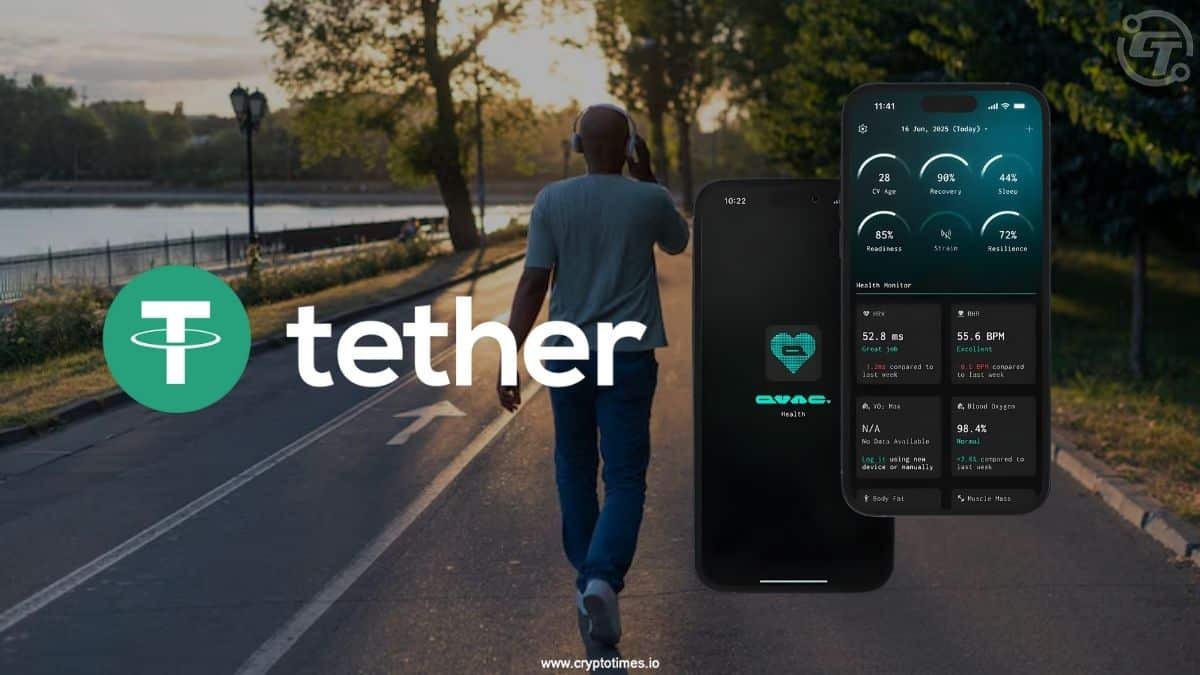
Tether, the company best known for issuing the world’s largest stablecoin, USDT, has officially launched QVAC Health ,a privacy-centric wellness platform that uses on-device artificial intelligence to help users manage and track health data without sacrificing personal privacy.
QVAC Health aims to solve a growing problem in the digital era: how to track and interpret personal health metrics without surrendering sensitive data to cloud servers and big tech platforms.
From fragmented wearable data (such as sleep patterns, exercise logs, and biometric readings) to nutrition entries and medication reminders, QVAC Health aggregates multiple health signals into a single encrypted dashboard , all processed locally on the user’s own device rather than on remote servers.
This means that, unlike conventional wellness apps that upload personal information to the cloud and often share it with advertisers or third parties, QVAC Health’s architecture ensures data stays private, encrypted and under the user’s control.
The platform incorporates advanced features, including:
- On-device AI processing: All artificial intelligence functions run directly on the user’s hardware, enhancing privacy and reducing dependence on centralized infrastructure.
- Unified health timeline: Users can view data from wearables like smart rings and fitness watches in one place.
- Natural language inputs: The interface allows users to log health observations or symptoms through text or voice, with the AI organizing entries into meaningful health narratives.
- Offline capability: The app continues to analyze and build insights without internet connectivity, further minimizing data exposure.
- Computer vision nutrition tracking: Experimental tools estimate calories and macronutrients from food photos ,entirely on the device without sharing images externally.
According to Tether, QVAC Health is designed as a “neutral ground for wellness data” ,breaking down the fragmentation caused by closed, proprietary ecosystems and centralized servers while giving users full control of how their information is stored and used.
QVAC Health represents a notable shift for Tether, which has traditionally focused on financial infrastructure, stablecoin issuance and blockchain liquidity services. Analysts see this move as part of a broader diversification strategy that taps into growing demand for privacy-first consumer technologies and local AI applications.
By processing health data on devices rather than in the cloud, the company hopes to appeal to users frustrated with large tech companies’ data practices, and to carve out a unique position at the intersection of AI, privacy, wellness and decentralized computing.
The launch of QVAC Health illustrates a bigger trend in both crypto and consumer tech: companies born in the digital-asset space are increasingly leveraging privacy-preserving technologies and decentralized design principles to build products beyond finance.
QVAC Health is now available on major mobile platforms and represents a major milestone for Tether as it pushes into new domains while continuing its long-term investment in decentralized AI and privacy technologies.
Read also: YouTube adds crypto stablecoin payouts for creators