
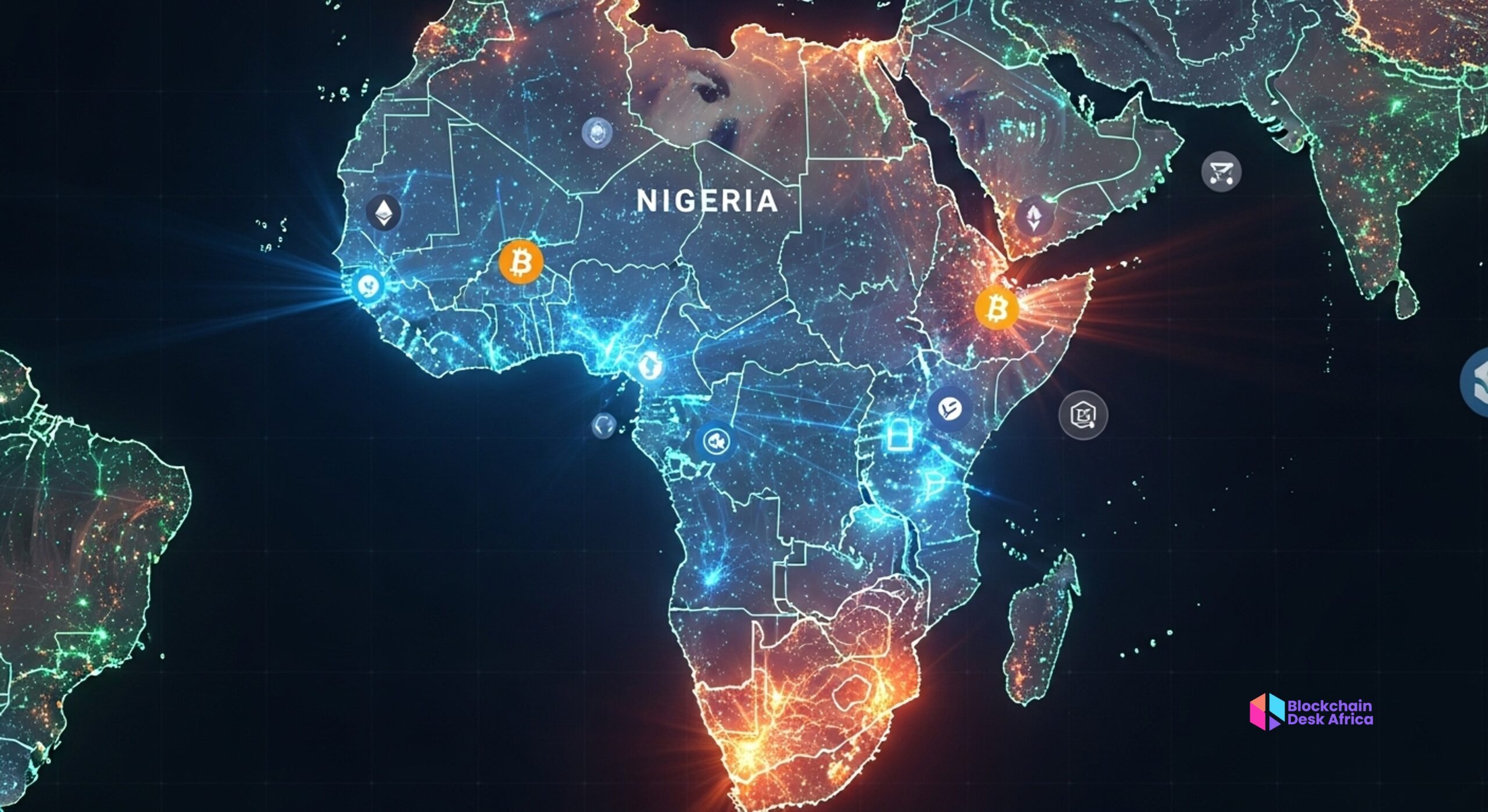
Sub-Saharan Africa is no longer a background story in the global crypto narrative. It has become one of the most active and influential regions in the world, showing how digital assets can serve real financial needs, not just investment goals.
Between July 2024 and June 2025, the region received more than $205 billion in on-chain value, representing a 52% year-over-year increase according to The 2025 Geography of Crypto Report by Chainalysis.
That growth was not driven by hype or speculation. It was driven by necessity.
Across Africa, people are using cryptocurrency to earn, save, send, and trade in ways their local banking systems often can’t support. From Lagos to Johannesburg, crypto is filling practical gaps, and in doing so, reshaping what finance looks like across the continent.
A Region Built on Practical Use Cases
Africa’s crypto story is powered by utility. Unlike in some regions where adoption is led by traders or institutions, the foundation here is real-world use. Chainalysis notes that Sub-Saharan Africa has one of the highest rates of grassroots adoption in the world, with a larger share of small retail transactions (under $10,000) than any other region.
Crypto here isn’t just a portfolio addition. It’s a lifeline.
People use it for remittances, cross-border trade, value preservation, and freelance income. It’s the solution to slow transfers, strict banking limits, and unstable local currencies.
In many ways, Africa has turned crypto into a working financial system where the traditional one falls short.
Nigeria: Where Crypto Meets Daily Life
No country in Africa demonstrates this better than Nigeria. With over $92 billion in crypto value received between July 2024 and June 2025, Nigeria leads the continent by a wide margin, almost triple South Africa’s total.
Its dominance is not just about numbers; it’s about how deeply crypto has become part of everyday life.
1. Protecting Against Inflation
The naira’s volatility has pushed Nigerians to find new ways to preserve value. Many now convert their earnings into stablecoins like USDT or USDC almost immediately after getting paid.
By holding digital dollars, they can protect themselves from the naira’s rapid depreciation and access a currency that holds steady value.
For countless families, this is a form of self-protection, a personal hedge against national inflation.
2. Receiving and Sending Payments
Nigeria is home to one of the world’s largest freelancer and remote work communities. Many of these workers receive payment in stablecoins or Bitcoin.
Instead of waiting days for international transfers or losing money to high fees, they receive funds instantly and can choose to hold or convert them locally.
The same is true for diaspora remittances. Crypto has become an alternative to traditional remittance channels, offering faster and cheaper transfers between families separated by distance.
3. Small Business and Trade
Across Lagos, Abuja, and Port Harcourt, small importers and merchants rely on crypto, especially stablecoin, to pay overseas suppliers.
With limited access to U.S. dollars in banks, crypto allows them to transact with partners in China, the UAE, and beyond.
These business owners aren’t chasing price movements; they’re keeping their trade alive using the only financial bridge that works consistently.
4. Peer-to-Peer Marketplaces
When Nigeria’s central bank restricted bank-linked crypto transactions in 2021, Nigerians responded with creativity. They built thriving peer-to-peer (P2P) networks, decentralised systems where individuals exchange crypto directly with one another.
By 2025, these P2P systems had matured into well-structured communities, allowing Nigerians to continue transacting securely outside formal banking controls.
The March 2025 surge in Nigerian crypto activity, recorded by Chainalysis, illustrates this adaptability. When the naira sharply devalued, crypto volumes spiked, a clear sign that people turned to digital assets as an immediate financial safety net.
South Africa: Regulation and Institutional Confidence
If Nigeria represents the retail heartbeat of African crypto, South Africa shows what structured adoption looks like.
While its total transaction volume trails Nigeria’s, its institutional maturity and regulatory progress make it a model for sustainable growth.
South Africa’s Financial Sector Conduct Authority (FSCA) began issuing Virtual Asset Service Provider (VASP) licenses, creating a compliant environment for banks, exchanges, and custodians.
This regulatory clarity has allowed traditional financial institutions to enter the space with confidence.
Institutional Patterns Emerging
- Bank Engagement: Major banks such as Absa and Standard Bank have started integrating crypto and blockchain solutions for institutional clients, a sign that crypto is entering mainstream financial services.
- Regulated Trading Activity: South Africa’s exchanges are seeing more professional traders and market makers, improving liquidity and making the market less volatile.
- Cross-Border Settlements: Businesses are adopting stablecoins for B2B payments, using blockchain rails to move funds quickly between regional partners without relying on the slow SWIFT network.
- Corporate Custody Solutions: Licensed custodians are offering secure storage for digital assets, allowing companies to diversify treasuries safely.
Why Africa’s Crypto Growth is Important
The African crypto market reflects a larger truth: when traditional systems fail to meet people’s needs, innovation fills the gap.
Cryptocurrency offers Africans something banks rarely deliver, speed, autonomy, and control.
It allows young entrepreneurs to run global businesses, families to save in stable currencies, and small traders to move money freely across borders.
The region’s success also proves that crypto’s strongest use cases emerge in places where economic pressure is real.
Africa isn’t speculating on the future of money, it’s using it today.
Who Should Pay Attention
1. Policymakers
Africa’s policymakers have a chance to shape regulation that works, not by restricting crypto, but by integrating it responsibly.
Nigeria and South Africa show two sides of the same opportunity: Nigeria’s energy and innovation, South Africa’s structure and compliance.
Governments can learn from both, creating balanced laws that protect citizens without stifling progress.
2. Financial Institutions and Fintechs
Banks, neobanks, and payment providers should take note of the opportunities in remittances, B2B settlement, and stablecoin custody.
Partnerships between fintechs and licensed exchanges could make cross-border commerce faster and cheaper than ever before.
3. Builders and Entrepreneurs
Developers and startups have open space to build solutions for local challenges, on-ramps, stablecoin wallets, P2P liquidity tools, or merchant payment systems.
The demand exists; what’s needed are products designed with Africa’s realities in mind.
4. Global Investors
For international investors and institutions, Africa’s crypto market is not a frontier, it’s a growing ecosystem with measurable scale.
The region’s $205 billion in annual transaction value is proof that this is a living market, not an experiment.
Final Thoughts
Sub-Saharan Africa’s crypto adoption is a story of resilience and reinvention.
Nigeria has shown how digital currencies can keep a fragile economy running, giving people control over their money when the local system fails.
South Africa has demonstrated that regulation and structure can coexist with innovation, creating space for institutions to participate safely.
Together, they represent two sides of the same transformation:
One was built from the ground up by necessity, and the other was guided from the top down by regulation.
Both are moving toward the same outcome, a financial landscape where access, efficiency, and inclusion come first.
Africa’s crypto boom is not a trend. It’s the blueprint for how emerging economies can rebuild finance in their own image, practical, fast, and borderless.