
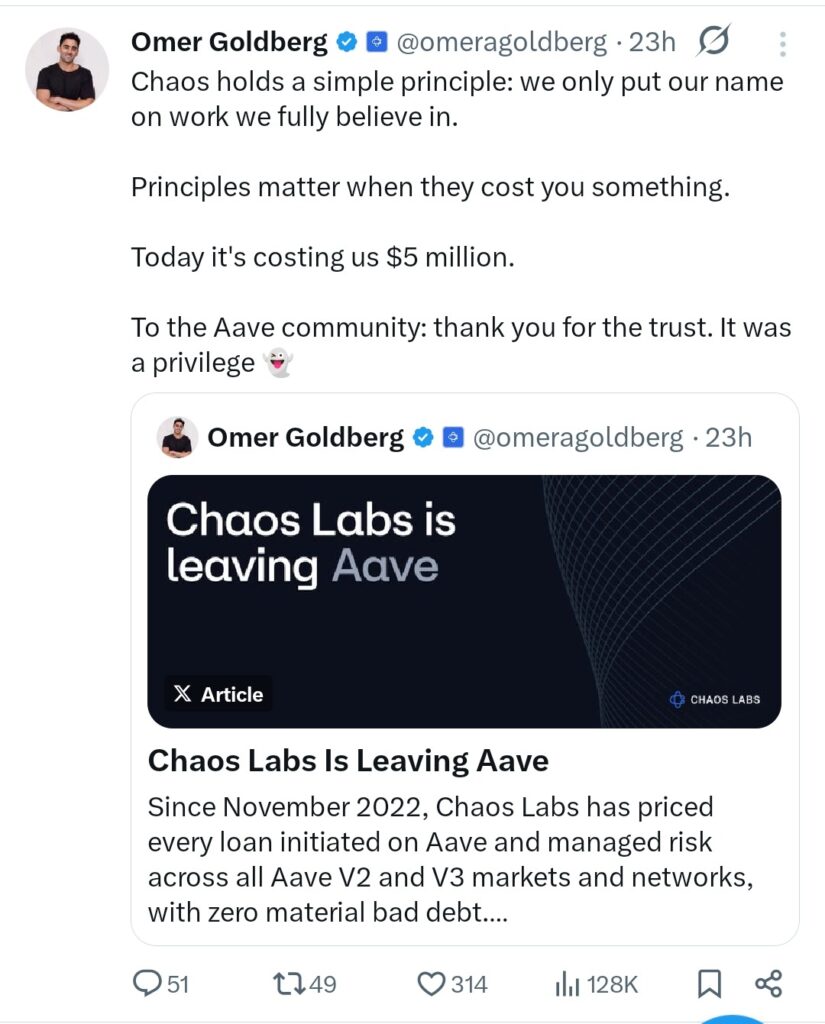
Chaos Labs a major risk management provider in the decentralized finance (DeFi) sector, has stepped down from its role as one of the two risk managers for the Aave DAO, marking the end of a partnership that played a significant role in shaping the decentralized finance (DeFi) protocol’s risk framework.
The decision was acknowledged by Aave founder and CEO Stani Kulechov, who confirmed the development in a detailed post on X (formerly Twitter). According to Kulechov, the transition will not disrupt Aave’s operations, and the protocol will continue functioning normally during the offboarding process.
CEO Responds to Chaos Labs Exit
In his statement, Kulechov expressed appreciation for Chaos Labs’ contributions over the years, noting that the firm helped strengthen Aave’s risk management structure as the protocol expanded.
“We respect the decision of Chaos Labs to step down as one of the two risk managers for the Aave DAO,” Kulechov wrote, adding that the firm had been “a valuable partner” whose work helped the protocol grow and mature.
He also reassured users that there would be no disruption to the Aave protocol, including its smart contracts, asset listings, or network deployments, while the transition is underway.
Disagreement Over Risk Management Proposal
While the departure appears amicable, Kulechov revealed that differences emerged regarding a proposal submitted by Chaos Labs.
According to the Aave founder, the DAO was generally supportive of increasing Chaos Labs’ risk management compensation to $5 million, roughly doubling its previous payment. However, Aave leadership did not agree with a request for $8 million without additional conditions, which was part of the broader proposal.
More significantly, the proposal included structural changes that Aave did not support. These included appointing Chaos Labs as the sole risk manager, replacing Chainlink price oracles with Chaos Labs’ own oracle system for new deployments, and adopting Chaos Labs vaults as the default vaults for business-to-business integrations.
Kulechov explained that while Aave does not question the quality of Chaos Labs’ products, the protocol prefers to maintain its two-layer risk management model, which distributes responsibilities between multiple providers.
Aave Emphasizes Decentralized Risk Oversight
The Aave ecosystem currently relies on a dual risk management structure handled by Chaos Labs and LlamaRisk. According to Kulechov, this approach occasionally creates disagreements between risk managers but ultimately strengthens the system by preventing centralized control.
He stressed that maintaining multiple providers reduces the risk of vendor lock-in and avoids creating a single point of failure for critical infrastructure.
Additionally, Aave leadership signaled continued support for Chainlink as the protocol’s primary oracle provider, noting the network’s long-standing reliability and the community’s comfort with its performance at scale.
The development sparked discussion among members of the crypto community on X, with some users supporting Aave’s decision to avoid consolidating risk management under one provider.
One user, AlexeyT, commented that allowing a single firm to act as the sole risk manager while also running price oracles and default vaults could introduce systemic risks. “One firm as sole risk manager… that’s a single point of failure,” the user wrote, adding that Kulechov made the right call.
Other commentators noted that disagreements between infrastructure providers are common in large DeFi protocols and often reflect broader debates around decentralization, governance, and control.
Following the exit of Chaos Labs, LlamaRisk is expected to take on a larger role in supporting Aave’s risk framework. Kulechov stated that Aave Labs will also provide additional engineering and analytical resources to ensure a smooth transition.
Despite the leadership change in its risk management team, Aave emphasized that the protocol’s core systems and upcoming developments remain unaffected.
The situation highlights an ongoing challenge for DeFi platforms: balancing collaboration with external service providers while preserving the decentralized principles that underpin their governance and security models.
Read also: Stablecoins strengthen dominance in crypto markets in Q1 2026