
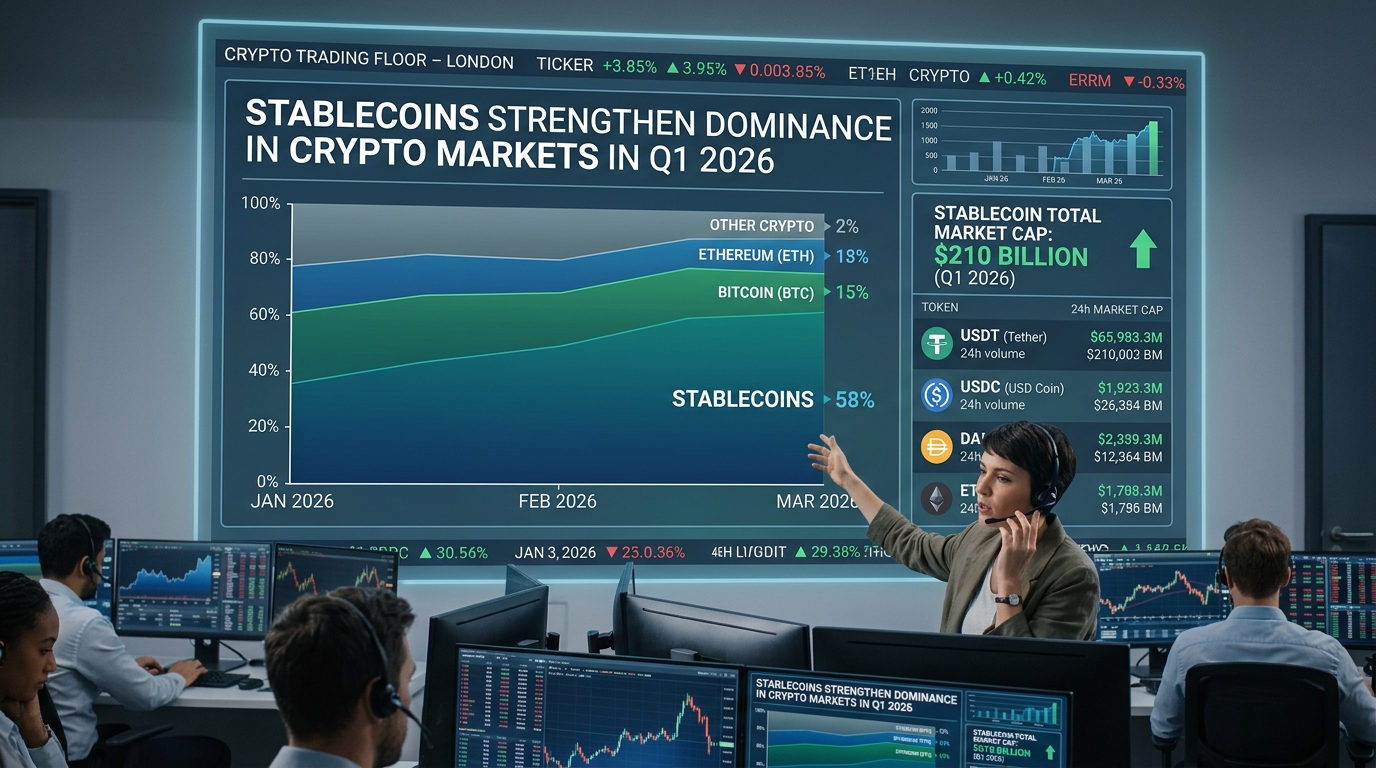
Stablecoins are consolidating their position at the center of the digital asset economy, with Q1 2026 data showing sustained growth in transaction activity, supply, and overall market influence despite volatility across major cryptocurrencies.
On-chain transaction volume for stablecoins climbed to an estimated $28 trillion during the quarter, reflecting a sharp increase from previous periods and reinforcing their role as the primary medium for value transfer across blockchain networks. In parallel, total circulating supply rose to around $315 billion, pointing to continued demand for dollar-pegged assets as both a transactional tool and a store of value.
A large share of this activity is tied to trading. Stablecoins accounted for close to 75% of total crypto trading volume in Q1, underlining their function as the dominant liquidity layer across both centralised exchanges and decentralised finance platforms. In practical terms, most trades are now routed through stablecoin pairs, making them essential to price discovery and market efficiency.
Also, beneath the headline figures, the structure of participation is evolving. Retail-driven transactions declined during the quarter, particularly in smaller transfer sizes, while large-value transactions increased. Automated systems and algorithmic trading strategies now account for a significant portion of stablecoin flows, signalling a market that is becoming more institutional, data-driven, and operationally efficient.
At the same time, innovation within the sector is accelerating. Yield-bearing stablecoins are gaining traction, offering users the ability to earn returns while maintaining price stability. These products are attracting capital from institutional investors, treasury managers, and advanced users seeking to optimise idle balances without taking on the volatility associated with traditional crypto assets.
Market leadership remains competitive. USD Coin continued to expand its presence during the quarter, particularly across regulated platforms and institutional channels, while Tether retained its dominant position in global liquidity, especially in emerging markets and high-frequency trading environments. The divergence reflects shifting preferences around transparency, regulatory alignment, and use-case flexibility.
The broader market context adds another layer of significance. While major cryptocurrencies experienced price corrections in Q1, capital did not exit the ecosystem at scale. Instead, funds rotated into stablecoins, reinforcing their role as a defensive asset during periods of uncertainty and market stress.
Taken together, these trends point to a market that is maturing beneath the surface. Stablecoins are no longer just instruments for traders,they are evolving into the settlement infrastructure that underpins the entire crypto economy. As regulatory frameworks continue to take shape and integration with traditional finance deepens, their role is expected to expand further, positioning them as a critical bridge between digital assets and the global financial system.
Read also: MicroStrategy currently Holds 4% of Bitcoin’s Total Supply