
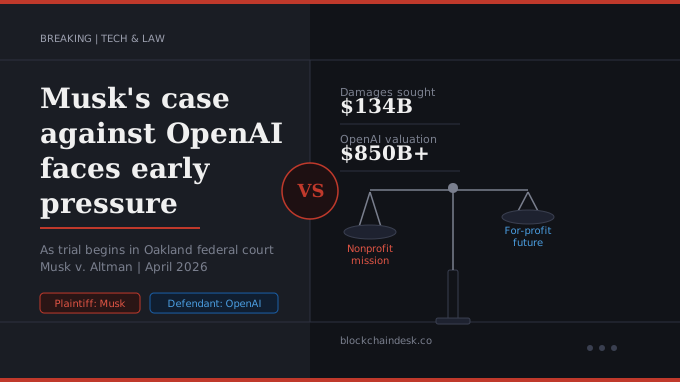
The legal battle between Elon Musk and OpenAI has hit early challenges in its first week, with courtroom exchanges raising questions about the strength of Musk’s claims.
Musk is suing OpenAI and its leadership, including Sam Altman, arguing that the company moved away from its original nonprofit mission and became a profit-driven business. He claims this goes against the founding goal of building artificial intelligence for the public good.
However, the first week of the trial showed that the case is more complex than it first appeared. During several days of testimony, Musk faced detailed questioning that exposed gaps and inconsistencies in his arguments. OpenAI’s legal team challenged his claims and questioned his motives, pointing to his own involvement in the AI space through his company, xAI.
Tension in the courtroom has been clear. There were moments of sharp exchanges during cross-examination, and the judge warned Musk about his public comments during the trial. This shows the case is not only about legal arguments, but also about conduct and credibility.
To understand the dispute, it is important to look at the history between Musk and OpenAI. Musk was one of the early backers of OpenAI when it was founded in 2015. At the time, the organisation was set up as a nonprofit with a clear mission, to develop artificial intelligence that benefits humanity and is not controlled by any single company.
Over time, OpenAI changed its structure. It created a “capped-profit” model to attract funding while still keeping part of its original mission. This allowed the company to raise large investments, including major backing from Microsoft. OpenAI argues that this structure was necessary to compete in the fast-growing AI industry, where building advanced models requires billions of dollars.
Musk, however, disagrees with this approach. He claims that OpenAI has become too focused on profit and partnerships, especially its relationship with Microsoft. He also argues that the company is no longer as open as it once promised to be, pointing to the fact that many of its technologies are now closed-source.
OpenAI has pushed back strongly. The company says Musk was aware of the need for funding and even supported similar ideas in the past. It also argues that Musk left the organisation years ago and is now criticising decisions made after his exit. Furthermore, OpenAI’s lawyers have suggested that Musk’s actions may be influenced by competition, given his involvement in building his own AI company.
Another key issue in the trial is control. Musk’s legal team argues that OpenAI’s partnership structure gives too much influence to commercial interests, which could affect how powerful AI systems are developed and deployed. OpenAI, however, maintains that its governance model still includes safeguards and oversight designed to protect its original mission.
There are also questions around transparency. Musk claims that OpenAI has reduced openness in its research and product releases. However, OpenAI argues that limiting access to some technologies is necessary to prevent misuse and manage safety risks, especially as AI systems become more powerful.
One of the key moments in the trial so far came when questions highlighted that Musk’s own ventures have used or benefited from OpenAI’s work. This weakened part of his argument and added another layer to the case.
The trial is expected to include testimony from other key figures in the tech industry. These could include executives, engineers, and early contributors who can speak to how decisions were made inside OpenAI. Their input may shape how the court understands the company’s transition and whether it stayed within its original goals.
The case also has wider implications. If Musk’s claims succeed, it could affect how AI companies structure themselves in the future. It may lead to stricter rules on how nonprofit missions are maintained when companies take on large investments. However, if OpenAI’s position holds, it could reinforce the idea that large-scale AI development requires flexible business models.
The outcome may also influence how governments approach AI regulation. Policymakers are already debating how to balance innovation with accountability. This case adds real-world detail to that debate, showing how difficult it is to maintain public-interest goals while operating in a competitive market.
Read also: TON launches agentic wallets, pushing AI into real onchain finance