
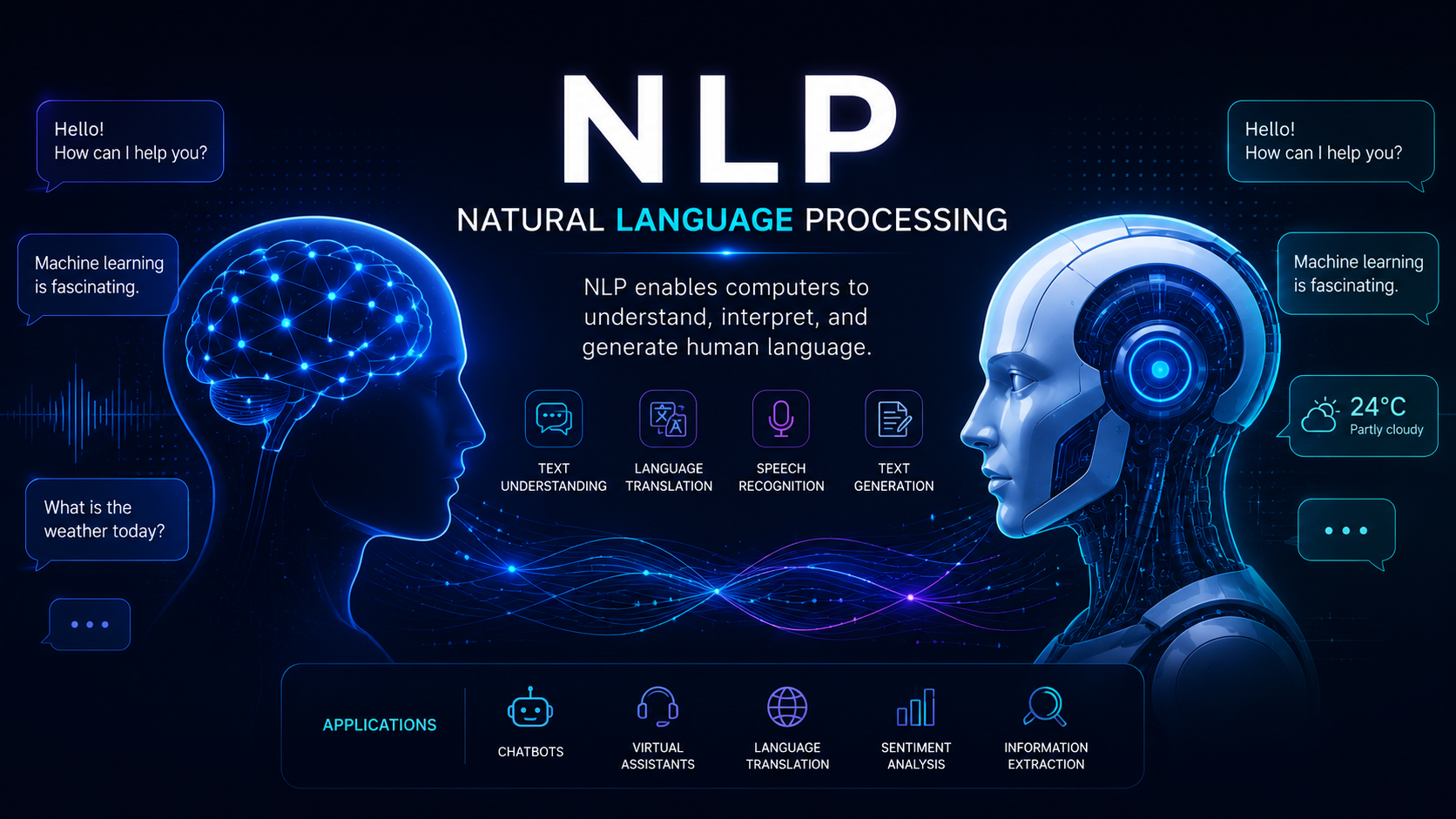
Remember that time you asked Siri a question? How about the other day you Google translated a webpage in seconds, every time a chatbot resolves your complaint without putting you on hold, and every time your email app suggests how to finish your sentence before you do, one technology is working quietly underneath all of it. It is called Natural Language Processing, and it is one of the most consequential and least understood branches of artificial intelligence in use today.
Most people have interacted with NLP hundreds of times without ever knowing its name. That is partly what makes it so worth understanding. It is not an emerging technology waiting to arrive. It is already here, already embedded in the tools billions of people rely on daily, and it is getting more capable at a pace that is reshaping entire industries. This article explains what NLP is, how it works, where it shows up in real life, and why it matters as AI becomes more central to how the world operates.
The Problem NLP Was Built to Solve
Computers are fundamentally built to work with structured, precise data. Numbers, code, commands, database entries, these are things machines handle without difficulty because they follow clear, consistent rules. Human language is the opposite of that. It is messy, contextual, ambiguous, and constantly changing.
The same word can mean completely different things depending on the sentence it appears in. The word “bank” could refer to a financial institution, the side of a river, or the act of tilting an aircraft. Sarcasm means the opposite of what the words literally say. Jokes rely on subverted expectations. Informal speech breaks every grammatical rule in ways that still make perfect sense to another human but are deeply confusing to a machine trying to process raw text.
For most of computing history, this gap between human language and machine understanding was simply accepted as a limitation. People adapted to machines by learning to interact with them in machine-friendly ways: precise search queries, structured commands, dropdown menus, checkboxes. Natural Language Processing flipped that relationship. Instead of humans adapting to machines, NLP makes machines adapt to humans, enabling them to understand language the way people actually use it, casually, imprecisely, and with layers of meaning that go far beyond the literal words.
What Is Natural Language Processing ?
Natural Language Processing is a branch of artificial intelligence that enables computers to read, understand, interpret, and generate human language. It combines linguistics, the scientific study of language, with machine learning and deep learning to build systems that can make sense of text and speech in context, not just at the surface level of individual words.
The scope of what NLP covers is broader than most people realise. It includes the ability to identify what language a piece of text is written in, break a sentence into its grammatical components, determine the emotional tone of a piece of writing, extract specific information from a large body of unstructured text, translate content from one language to another, summarise a long document into a concise version, and generate new language that is coherent and contextually appropriate. Each of these capabilities represents a different application of the same underlying set of techniques, and most of the AI tools people use today rely on several of them at once.
The reason NLP has advanced so dramatically in recent years is the same reason the rest of AI has: the combination of massive datasets, deep learning architectures, and the computing power to train large models on both. Large language models, the technology powering tools like ChatGPT and Claude, are the most advanced form of NLP systems built to date. They are trained on extraordinary volumes of text and have developed a nuanced, layered ability to process and generate language that would have been unthinkable even a decade ago.
How NLP Works
When an NLP system receives a piece of text or spoken input, it does not process it the way a human reader does. It runs the input through a sequence of analytical steps that progressively build a structured understanding of what the language means and what the appropriate response should be.
The first step is breaking the input down into smaller, manageable pieces. This process, known as tokenisation, splits a sentence into individual words or meaningful units that the system can analyse separately. Filler words that carry little meaning, such as “and,” “the,” and “for,” are often stripped away at this stage to reduce noise and help the system focus on the parts of the text that carry the most information.
The next step involves identifying the grammatical role of each token, determining which words are nouns, verbs, adjectives, and so on, and mapping out the relationships between them. This grammatical analysis lays the groundwork for understanding the structure of the sentence before the system attempts to interpret its meaning.
From there, the system moves into semantic analysis, where it draws on patterns learned from its training data to understand the context and intent behind the words. This is where the real complexity of NLP lives. Determining that “jaguar” in one sentence refers to the animal and in another refers to the car brand requires the system to read context across the full sentence, and sometimes across multiple sentences, before it can arrive at the correct interpretation. Understanding sentiment, identifying named entities like people, organisations, and locations, detecting irony, and inferring intent from vague or indirect phrasing are all part of this stage.
Finally, the system generates a response or an output, whether that is a translated version of the original text, a summary, an answer to a question, or a continuation of the conversation. In modern large language models, this generation step is itself a sophisticated NLP process, producing output that reflects not just the content of the input but its tone, register, and implied expectations.
Where NLP Shows Up in Everyday Life
The applications of Natural Language Processing are so widespread that it is easier to list the digital experiences that do not rely on it than those that do. Here are some of the most common places NLP is already at work.
Search engines use NLP to interpret what a user is actually looking for rather than just matching the keywords in the query to pages that contain those words. When someone types a question into Google, the search engine uses NLP to understand the intent behind the question and surface results that answer it, even if those results do not contain the exact words used in the query.
Voice assistants like Siri, Alexa, and Google Assistant are entirely NLP-powered. Every spoken command is converted from audio into text, processed through NLP systems that identify the intent and extract the relevant information, and then executed or responded to accordingly. The seamlessness of a good voice assistant interaction is a direct reflection of how advanced NLP has become.
Translation tools like Google Translate and DeepL use NLP to convert text from one language to another while preserving meaning, tone, and context as accurately as possible. This is one of the most technically demanding NLP tasks because it requires understanding not just vocabulary but the structural differences between languages and the cultural nuances that shape how meaning is expressed differently across them.
Customer service chatbots use NLP to understand the nature of a customer’s complaint or query, classify it into the appropriate category, and either resolve it directly or route it to the right human agent. Sentiment analysis tools use NLP to read large volumes of social media posts, reviews, and feedback and determine whether the overall tone is positive, negative, or neutral, giving businesses a real-time view of how people are responding to their products and communications.
Autocomplete and predictive text features use NLP to anticipate what a user is likely to type next based on the context of what they have already written. Email platforms that suggest how to finish a sentence are doing the same thing on a slightly larger scale. Every one of these features is powered by a system that has learned the patterns of human language well enough to predict, with surprising accuracy, what comes next.
The Importance of NLP in 2026
The majority of the world’s information exists in text. Reports, contracts, social media posts, customer feedback, medical records, research papers, news articles, legal documents: all of it is written in natural language, which means all of it has historically been difficult for machines to process and analyse at scale. NLP changes that. By enabling computers to read and understand unstructured text, NLP turns an enormous volume of previously inaccessible information into something that can be searched, summarised, classified, and acted upon.
For businesses, this is transformative. Support teams can automatically classify and prioritise incoming tickets. Marketing teams can analyse customer sentiment across thousands of reviews in minutes. Legal teams can search through contracts for specific clauses without reading every page manually. Healthcare providers can extract structured information from clinical notes that were written in plain language. In every case, NLP is converting unstructured human language into structured, actionable intelligence.
For individuals, the impact is felt in the quality and naturalness of every digital interaction. The more capable NLP systems become, the more interactions with technology feel like interactions with something that actually understands you, rather than something you need to learn to communicate with on its own terms.
The Language That Teaches Machines to Listen
Natural Language Processing is the technology that bridges the gap between human communication and machine understanding. It is the reason people can speak to their devices and be understood, search in plain sentences and find relevant results, and interact with AI tools that respond with a fluency that feels genuinely conversational.
It is not a perfect technology. Handling sarcasm, cultural nuance, low-resource languages, and highly ambiguous phrasing remain active challenges. But the progress made in NLP over the past decade has been extraordinary, and the systems in use today are more capable, more contextually aware, and more natural to interact with than anything that existed before them.
Understanding NLP does not require a background in linguistics or machine learning. It only requires recognising that behind every natural, seamless interaction between a human and a machine, there is a technology working hard to make the machine worthy of the conversation.
Read also: Generative AI Explained: What It Is and How It Creates Things