
Something changed in the public conversation about artificial intelligence around 2022, and it has not stopped shifting since. For most of the previous decade, AI was something that happened in the background, quietly powering search results, filtering spam, and flagging fraudulent transactions without most people ever interacting with it directly.
Then a new category of AI arrived that did something different. Instead of analysing what already existed, it started creating things that had never existed before. Text, images, music, video, code, all of it generated from scratch in response to a simple instruction. That category has a name: generative AI, and it is the force behind the most visible and most talked-about AI tools in the world today.
Understanding what generative AI is, how it works, and why it represents something genuinely new in the history of technology is not just useful for developers or business leaders. It is useful for anyone who wants to make sense of the world they are living and working in right now, because generative AI is already changing how content is created, how software is built, how research is conducted, and how people communicate across almost every industry on the planet.
What Is Generative AI ?
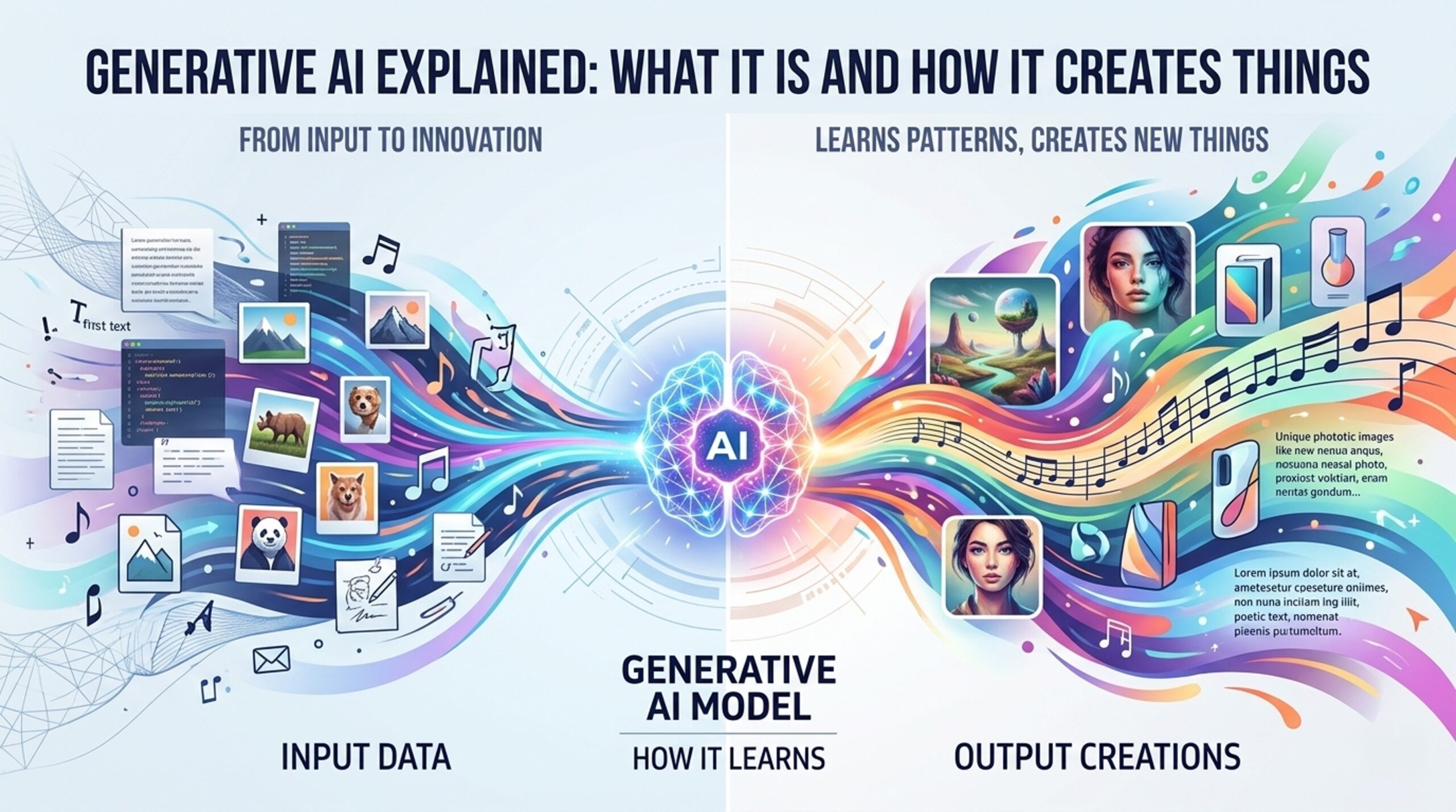
Generative AI refers to artificial intelligence systems that are designed to produce new content in response to a prompt or instruction. That content can take many forms: written text, photographic-quality images, audio recordings, video clips, computer code, or combinations of all of the above. What defines generative AI is not the format of its output but the nature of what it does. It creates something original rather than simply retrieving, sorting, or classifying something that already exists.
This is a meaningful distinction. Most AI systems that came before the generative era were built to analyse. A fraud detection system analyses transaction data to identify suspicious patterns. A recommendation engine analyses viewing history to predict what a user might want to watch next. A spam filter analyses the content of incoming emails to decide which ones to block. All of these systems are doing something valuable, but what they are doing is fundamentally analytical. They process existing information and produce a judgment about it.
Generative AI does something categorically different. Given a text description of an image, it produces the image. Given a topic and a tone, it produces a written article. Given a programming task, it produces working code. The output is not retrieved from a database or selected from a pre-existing library. It is constructed, piece by piece, based on patterns the model has learned from an enormous volume of training data. That capacity to construct rather than retrieve is what makes generative AI a different kind of technology from what came before it.
How Generative AI Creates Things
The creative output of generative AI does not emerge from imagination or intuition. It emerges from pattern recognition operating at an extraordinary scale. To understand how this works, it helps to trace the process from the beginning.
Every generative AI model starts with training. During training, the model is exposed to a massive dataset of existing content, millions or billions of examples of the kind of content it is being built to generate. A language model is trained on vast quantities of text drawn from books, articles, websites, and other written sources. An image generation model is trained on hundreds of millions of images paired with text descriptions. A music generation model is trained on large libraries of audio recordings. In each case, the model is not memorising the training data. It is learning the underlying patterns, structures, and relationships that make the content coherent and meaningful.
Once training is complete, the model can use those learned patterns to generate new content in response to a prompt. When a user types an instruction into a generative AI tool, the model interprets that instruction, draws on everything it has learned about the relevant patterns and structures, and constructs a response that fits the request. A language model predicts the most appropriate sequence of words, one token at a time, based on the context of the prompt and the patterns in its training. An image model uses a different architectural process but follows the same fundamental logic: generate output that matches the patterns associated with the given description.
What makes the output feel creative is that the model is not copying any single example from its training data. It is synthesising across millions of examples to produce something new that reflects the patterns of all of them. The result is output that can feel genuinely original, because in a meaningful sense it is.
The Technologies Powering Generative AI
Generative AI is not a single technology. It is an umbrella term for a family of approaches, each suited to generating different types of content. Understanding the main ones helps clarify why different generative AI tools behave differently and produce different kinds of output.
Large language models are the technology behind text-based generative AI tools like ChatGPT and Claude. These models are trained on vast amounts of written text and learn to generate coherent, contextually appropriate language in response to a prompt. They are the reason a generative AI tool can write a persuasive essay, summarise a long document, answer a complex question, or draft a professional email with a level of fluency that can be difficult to distinguish from human writing.
Diffusion models are the primary technology behind image generation tools like Midjourney and DALL-E. These models learn to generate images by training on the process of gradually refining noise into a coherent picture. When given a text prompt, a diffusion model uses what it has learned about the relationship between language and visual content to construct an image that matches the description. The results can range from photorealistic renderings to stylised illustrations, depending on how the model was trained and what the prompt specifies.
Multimodal models represent the most recent and most expansive development in generative AI. These systems are not limited to a single type of input or output. They can process text, images, audio, and video simultaneously and generate responses that combine multiple formats. A multimodal model can receive a photograph and a written question about it and respond with a detailed text analysis. It can take a written description and produce both an image and an accompanying audio narration. This ability to work fluidly across different content types is rapidly expanding what generative AI can do and where it can be applied.
What Generative AI Is Already Being Used For
The range of real-world applications for generative AI has grown faster than most predictions anticipated, and it continues to expand. In content creation, writers, marketers, and journalists are using generative AI tools to draft, edit, and refine written content at a speed that was not previously possible. The tools do not replace the judgment and expertise of the human professional, but they compress the time required for the mechanical parts of the writing process significantly.
In software development, generative AI coding assistants are producing functional code from plain-language descriptions, suggesting fixes for bugs, and helping developers navigate unfamiliar codebases. In design and visual media, image and video generation tools are enabling creators to produce high-quality visual content without requiring traditional production infrastructure. In scientific research, generative AI is being used to simulate molecular interactions, model complex systems, and generate hypotheses that would take human researchers far longer to develop independently.
The common thread across all of these applications is the same. Generative AI is compressing the distance between an idea and a realised output. Tasks that previously required hours of manual work can now be initiated with a prompt and refined from there. That compression does not eliminate the need for human expertise, judgment, or creativity. It changes where those things are most needed, shifting the focus from execution toward direction and evaluation.
What Generative AI Cannot Do
For all of its capabilities, generative AI has clear and important limitations that anyone using it should understand. The most significant is that it does not reason or understand in the way humans do. A language model generating a paragraph of text is predicting plausible word sequences based on learned patterns. It is not thinking through the logic of what it is saying, verifying the accuracy of the claims it is making, or drawing on genuine comprehension of the topic. This is why generative AI can produce fluent, convincing text that contains factual errors, a limitation covered in depth in the AI hallucinations article in this series.
Generative AI is also dependent entirely on its training data. It can only generate content that reflects the patterns and knowledge embedded in that data. It cannot access information it was not trained on, unless it is connected to a real-time retrieval system, and it cannot apply judgment to situations that fall outside the scope of what its training covered.
These limitations do not diminish the value of generative AI. They define the conditions under which it is most useful and underscore why human oversight remains essential whenever the output carries real consequences.
The Tool, Not a Replacement for Thought
Generative AI is the most publicly visible development in the history of artificial intelligence, and for good reason. The ability to create original content from a text instruction is a genuinely new capability, one that is changing what individuals can produce, what businesses can build, and what researchers can explore. Understanding what it is and how it works is the foundation for using it well and for making informed judgments about where it fits and where it does not in any given context.
The technology is not magic, and it is not a replacement for human intelligence. It is a powerful creative tool that is most effective in the hands of someone who understands both its capabilities and its limits. That understanding starts here.
Read also: Court jails man for stealing 107 Bitcoin using memorised seed phrase