
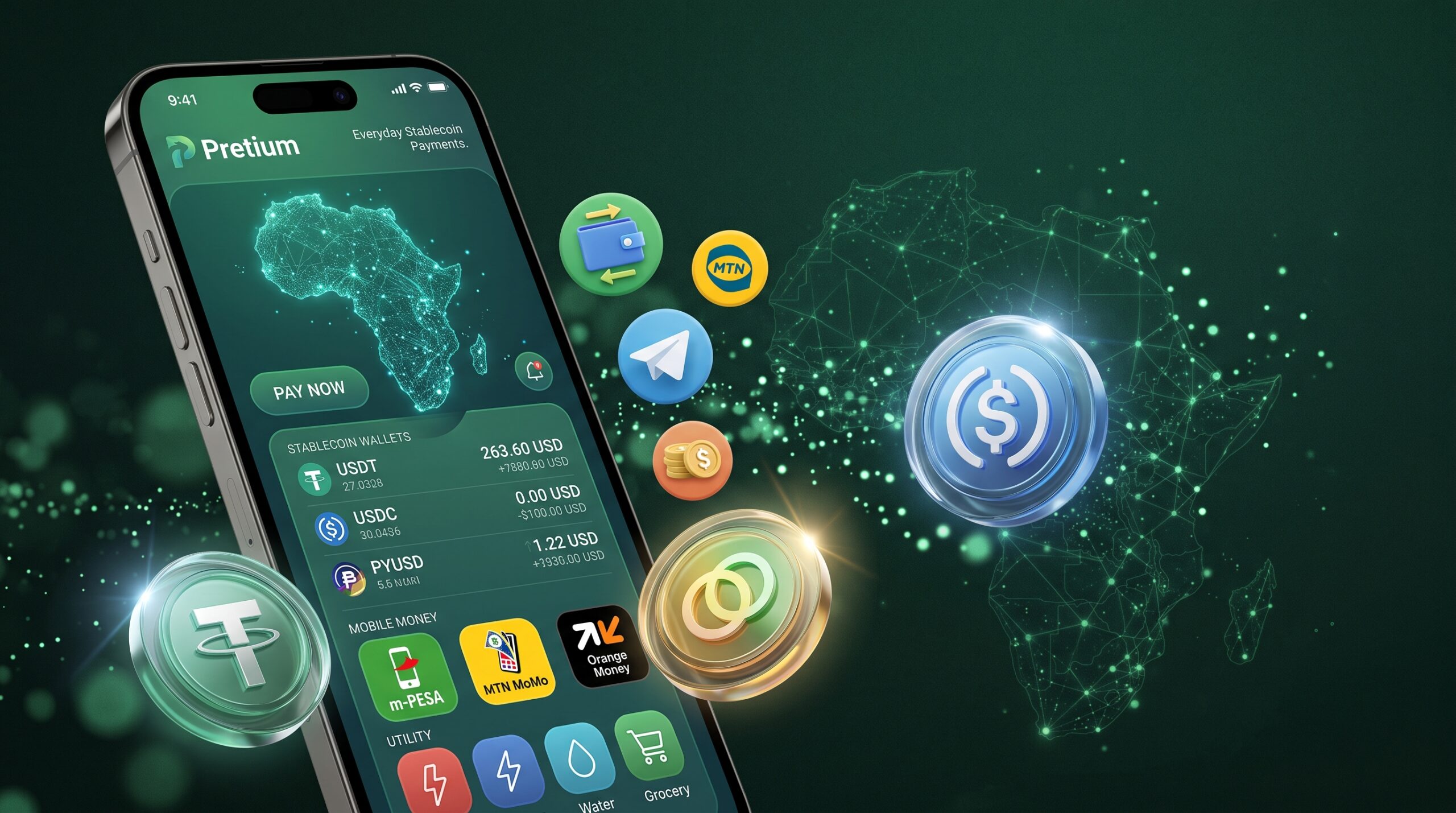
Sending money across Africa can involve several different systems, from blockchain networks and cryptocurrency wallets to mobile money providers and traditional bank accounts. Pretium connects these systems, allowing people and businesses to use stablecoins to pay merchants, settle bills, and transfer money through familiar local payment channels.
Founded in 2023, Pretium Finance is a fintech company building stablecoin payment infrastructure for African markets. Its platform connects digital assets such as USDT and USDC with local currencies and payment networks, including mobile money services and bank transfers. Users can access its services through a consumer application, while businesses can integrate its payment infrastructure through APIs and an e-commerce checkout tool.
The company has also expanded into AI-powered payments, allowing developers to connect AI agents to payment services and establish rules governing how those agents spend money. This adds programmable payments to Pretium’s existing stablecoin infrastructure.
Building a bridge between crypto and local payments
Pretium’s development centres on a practical use of blockchain technology: making digital assets useful for everyday financial transactions.
Stablecoins are cryptocurrencies designed to maintain a relatively stable value against a reference asset, usually a fiat currency such as the US dollar. USDT and USDC are two widely used examples. People can hold them in digital wallets and transfer them across supported blockchain networks.
However, paying for groceries, electricity, or other everyday expenses often requires local currency. Someone holding USDT may still need to convert it into Kenyan shillings or another local currency before paying a merchant through a conventional payment system.
Pretium connects these two sides. Its infrastructure processes stablecoin payments and coordinates the corresponding local-currency settlement through supported financial service providers.
This means a user can pay with stablecoins while a merchant receives funds through a mobile money account or bank account. The merchant does not necessarily need to hold cryptocurrency or manage blockchain transactions directly.
How Pretium works
Pretium operates through three main components: a consumer payment application, payment APIs for businesses, and an e-commerce checkout product.
For individual users, the mobile application provides access to stablecoin-powered payments. Users can hold digital assets in a blockchain wallet and use the application to make supported merchant payments, transfer money, and settle bills.
For businesses, Pretium provides APIs that connect stablecoin payments to local fiat currencies across multiple African markets. Companies can integrate these APIs into their existing applications instead of building separate payment connections for every market.
The e-commerce checkout product provides another route for adoption. Merchants can embed a checkout widget on their websites, allowing customers to pay with supported cryptocurrencies while the merchant receives local currency through the settlement process.
The three products serve different needs, but they share the same underlying purpose: connecting blockchain-based payments with the financial systems people and businesses already use.
Paying bills and merchants with stablecoins
Pretium’s consumer application is designed to let users spend stablecoins beyond cryptocurrency exchanges and Web3 applications.
Supported use cases include merchant payments, cross-border transfers, and bill settlements. Depending on the market and available payment routes, users can pay through local payment channels such as mobile money and bank transfers.
The company’s initial mobile application launch in January 2025 covered Kenya, Ghana, Nigeria, Uganda, and Malawi. At launch, Pretium highlighted everyday payments such as groceries, restaurant bills, fuel, and utility services as intended use cases for the product.
The process reduces the need for users to manually sell their stablecoins through a peer-to-peer marketplace before making a local payment.
Instead, Pretium manages the conversion and settlement process within its payment service. Its terms explain that digital assets are converted at an exchange rate determined by the platform, and a merchant or bill payment is considered complete when the corresponding fiat funds have been transferred to the merchant’s mobile money or bank account.
This approach makes stablecoins useful as a payment source rather than simply an asset to hold or trade.
APIs for fintechs and businesses
Pretium’s payment API is designed for businesses that want to integrate stablecoin-to-fiat payment functionality into their products.
The API supports USDT and USDC conversions into local currencies across seven or more African markets, according to the company’s current website. Supported markets include Kenya, Uganda, Nigeria, Ghana, Zambia, Malawi, and the Democratic Republic of Congo. Available currencies and payment methods vary by market.
A business can use the infrastructure to accept stablecoin payments, initiate payouts, and connect transactions to local payment methods.
One feature Pretium highlights is that businesses do not need to pre-fund destination markets before processing payments. This can reduce the need to keep capital locked in multiple countries just to serve customers in different markets. The company also advertises instant settlement across supported routes.
For example, a digital service provider with customers in several African countries could integrate Pretium to collect stablecoin payments and settle funds through supported local payment networks.
The business would not need to develop an independent integration with every mobile money operator or build its own stablecoin conversion system. Pretium provides the underlying payment infrastructure, while the business maintains its own customer-facing application.
E-commerce checkout for online merchants
The product is a lightweight, embeddable checkout widget designed to let merchants accept cryptocurrency payments without building an entire crypto payment system. According to its documentation, customers can choose a supported network and asset, review the amount required, and complete the payment using a compatible wallet or exchange application.
The payment process begins when a customer selects the crypto payment option. The checkout system retrieves the amount to be paid, the destination address, the applicable exchange rate, and the payment expiry time.
The customer then sends the required amount. Once the blockchain transaction is confirmed, the checkout updates the payment status and directs the customer back to the merchant’s website.
The merchant can configure automatic settlement to a mobile money or bank account, or choose to withdraw funds manually through the merchant dashboard. The customer pays with a digital asset, while the merchant receives local currency.
This design makes the product relevant to e-commerce businesses that want to serve crypto users without requiring their finance teams to manage cryptocurrency balances directly.
The Web3 infrastructure behind Pretium
Pretium’s connection to Web3 comes from its use of blockchain networks and stablecoins as part of the payment process.
Stablecoins allow value to move between digital wallets without relying exclusively on traditional bank transfers. Blockchain networks record transactions and allow users to transfer supported assets between addresses.
Pretium connects this blockchain activity to local payment infrastructure. Its checkout documentation identifies Celo, Base, and BNB Chain as supported networks for stablecoin settlement.
This connection is important because a blockchain transfer and a local payment are not the same thing. Sending USDC to a wallet does not automatically deposit money into a mobile money account. A payment provider must connect the on-chain transaction to a conversion and payout process.
Pretium’s infrastructure is designed to coordinate these steps, allowing users to initiate payments with stablecoins while merchants and billers receive funds through supported local financial networks.
The result is a service that uses blockchain technology behind the scenes without requiring every merchant or recipient to interact directly with a blockchain.
Expanding into AI-powered payments
Pretium’s newer product direction includes agentic payments, which allow AI agents to initiate and execute financial transactions within predefined rules.
An AI agent is software that can perform tasks on a user’s behalf. When connected to payment infrastructure, it can do more than provide information or recommendations. It can also initiate actions such as paying invoices, settling bills, or sending money, provided it has the necessary permissions.
Pretium’s current website describes a system in which users register an agent, define spending policies, and connect it to an AI workflow through the Model Context Protocol (MCP) or a REST API.
MCP is a standard that allows AI applications to connect to external tools and services. Through this type of integration, an AI assistant can interact with Pretium’s payment functions rather than merely telling the user how to make a payment.
The company says users can set limits for individual transactions, daily spending, and monthly budgets. Agents can then execute payments within those permitted boundaries.
Supported actions include sending fiat funds to mobile money accounts, paying bills, transferring money to bank accounts, and sending USDT or USDC through supported blockchain networks. The platform also advertises scheduled payments for recurring bills.
For example, a business could configure an AI agent to pay recurring invoices up to a specified amount. The agent could initiate payments when they are due, while the spending policy determines which transactions it can execute automatically.
This approach combines stablecoin infrastructure with programmable financial controls. It also introduces new considerations around permissions, transaction limits, monitoring, and the ability to review or stop automated payments.
Compliance and local payment partnerships
Connecting blockchain payments to local financial systems requires compliance processes and relationships with payment providers.
Pretium says it partners with licensed payment service providers to support transactions within regulated frameworks. Its onboarding process includes Know Your Customer checks for individuals and Know Your Business checks for companies, depending on the service being accessed.
The company also provides customer support and transaction records through its application and support channels. Its terms state that completed blockchain transactions are irreversible, making it important for users to check payment details before confirming a transfer.
The regulatory requirements for stablecoin payments differ across African countries. The availability of particular currencies, mobile money providers, bank transfers, and conversion routes therefore depends on the country and the relevant payment partners.
Pretium’s partner-based approach allows it to connect its stablecoin infrastructure with local financial services without presenting every payment route as if it operates under one uniform regulatory framework.
Growth and ecosystem development
Pretium launched its consumer application in January 2025, extending its focus on stablecoin infrastructure into everyday payments across several African markets. The launch was announced through the Celo community, reflecting the company’s involvement in an ecosystem that has supported stablecoin payment use cases.
In April 2026, Disrupt Africa featured Pretium’s work connecting blockchain infrastructure with mobile money and banking networks in Kenya. The company’s current website also lists its participation in the Visa Africa FinTech Accelerator and its presence at Africa Tech Summit Nairobi 2026.
Its product development now spans consumer payments, merchant checkout, business APIs, and agentic payments. This progression suggests an effort to serve both people who want to spend stablecoins and businesses that need programmable payment infrastructure.
Pretium’s current website lists a 99.99% transaction success rate and coverage across seven or more markets. These are company-reported figures, and the website does not provide a full methodology or reporting period alongside the headline metrics.
The company has also introduced a connection between stablecoin payments and AI tools, giving developers a way to incorporate financial actions into automated workflows.
Making digital money useful in everyday life
Pretium is working on a part of the Web3 ecosystem that is easy to overlook: the infrastructure required to turn digital assets into practical payments.
Its consumer application allows users to spend stablecoins on supported everyday transactions. Its APIs and checkout tools give businesses a way to accept digital assets while receiving funds through local payment channels. Its agentic payment system extends those capabilities to AI applications that can initiate transactions within defined spending rules.
Together, these products connect blockchain networks, stablecoins, mobile money, bank transfers, and software-based automation.
The value of this model depends on how reliably payments move between these systems, how widely the services are available, and how well the company manages the operational and compliance requirements of each market.
As stablecoins become more widely used for payments and AI applications gain the ability to take actions on behalf of users, infrastructure connecting digital assets with local financial systems could become increasingly important.
Pretium’s focus is to make that connection work across African markets, so that using stablecoins does not have to end at a wallet address but can extend to paying a merchant, settling a bill, or completing a business transaction.