
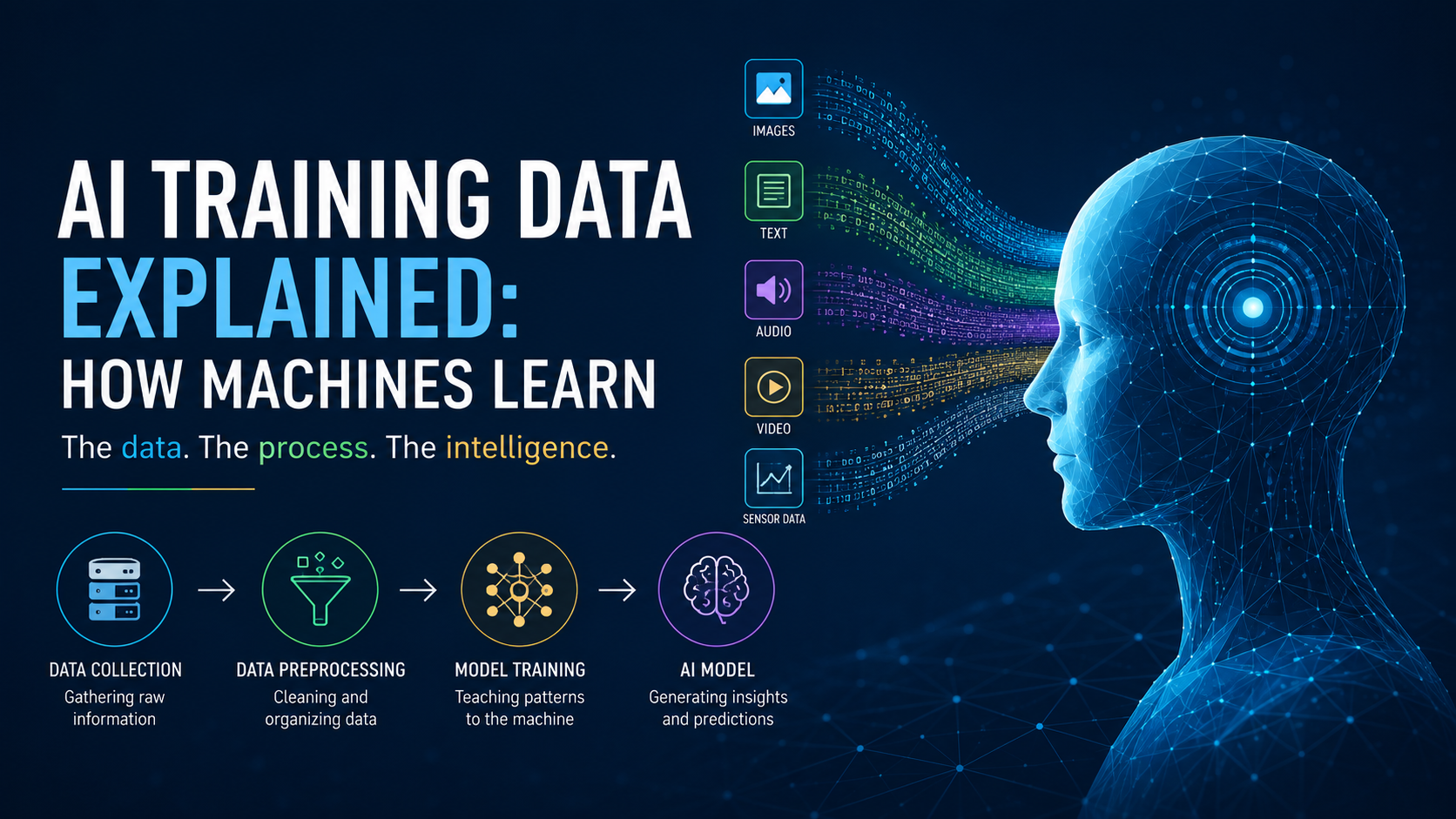
Every AI tool that exists today, whether it writes articles, recognises faces, recommends music, or drives a car, learned how to do what it does the same way. Not from instinct. Not from programming rules written by a human for every possible scenario. It learned from data. Enormous, carefully assembled collections of data that were fed into a system repeatedly until the system became capable of recognising patterns, making predictions, and producing outputs that reflect genuine understanding of the task it was built for.
The phrase “AI learns from data” gets repeated constantly in conversations about artificial intelligence, but is rarely explained. What does it actually mean for a machine to learn? What happens inside an AI system during training? What kind of data is used, where does it come from, and why does the quality of that data matter so much? These are the questions this article answers, clearly and without unnecessary complexity.
The most useful way to understand how AI learns is to compare it to how a child learns to read. When a child is first learning the alphabet, they are shown letters repeatedly, each time accompanied by the name of the letter and the sound it makes. Over hundreds of repetitions across days and weeks, the child builds an internal model that connects the visual shape of each letter to its name and sound. Eventually, they no longer need to be told. They see the letter, and they know. The pattern has been learned.
AI training works on the same principle. Instead of a teacher holding up flashcards, a machine learning model is fed thousands or millions of labelled examples. Instead of a child building an internal model through repeated exposure, the AI adjusts the numerical weights in its neural network through repeated cycles of prediction and correction. The mechanism is different, but the core logic is identical: exposure to enough examples, combined with feedback on what is right and what is wrong, produces a system that can handle new situations it has never encountered before.
What Training Data Is
Training data is the information used to teach a machine learning model. It is the raw material from which an AI system builds its understanding of the world it is being trained to operate in. Without training data, there is nothing for the model to learn from, and no AI capability is produced.
Training data comes in many forms depending on what the AI system is being built to do. A language model is trained on text, vast quantities of books, articles, websites, research papers, and other written sources that give the model exposure to the patterns, structures, and relationships that make human language work. An image recognition system is trained on photographs, typically accompanied by labels that describe what each image contains. A speech recognition system is trained on audio recordings paired with transcriptions. A fraud detection model is trained on historical transaction data, with labels indicating which transactions were fraudulent and which were legitimate.
The data used in training is almost always divided into three separate sets. The training set is the largest portion, and it is what the model learns from directly. The validation set is used during training to monitor the model’s performance on data it has not seen and to catch problems like overfitting, where a model becomes too specialised to its training data and loses the ability to generalise to new examples. The test set is held back entirely until training is complete and is used to evaluate how well the finished model performs on genuinely unseen data. This three-way split is a standard practice in AI development because it provides an honest measure of whether the model has truly learned or has simply memorised.
The Three Main Ways AI Learns
AI does not learn singly. The approach used depends on the type of problem being solved and the nature of the data available. Three core learning strategies power the vast majority of AI systems in use today.
Supervised learning is the most widely used approach. In supervised learning, every example in the training data comes with a label that tells the model what the correct output should be. An image labelled “cat” teaches the model to associate certain visual patterns with that category. A transaction labelled “fraudulent” teaches the model to associate certain patterns in the transaction data with suspicious activity. The model makes a prediction, compares it against the correct label, measures the error, and adjusts its internal parameters to reduce that error. This cycle, called training, repeats across the entire dataset many times until the model reaches an acceptable level of accuracy. Supervised learning works well when large quantities of labelled data are available, and the task can be clearly defined in terms of input and correct output.
Unsupervised learning takes a different approach. The training data contains no labels. Instead of learning to map inputs to predefined outputs, the model learns to find structure and patterns in the data on its own. Clustering algorithms, which group similar data points together without being told what the groups should be, are a common example of unsupervised learning in action. This approach is useful when the patterns in the data are not known in advance or when the cost of labelling large datasets is prohibitive. It is also the foundation of many recommendation systems, which discover natural groupings in user behaviour data without being given explicit categories to work from.
Reinforcement learning operates on a completely different logic. Instead of learning from a fixed dataset, a reinforcement learning system learns through interaction with an environment. The system takes actions, receives rewards or penalties based on the outcomes of those actions, and gradually learns to take the actions that maximise reward over time. This is the approach behind AI systems that have learned to play complex games like chess and Go at a superhuman level, and it is increasingly being used to train AI agents that can complete multi-step tasks in dynamic environments.
Why Data Quality Changes Everything
There is a principle in computing that predates artificial intelligence and remains just as true today: garbage in, garbage out. The quality of an AI model’s output is directly and unavoidably tied to the quality of the data it was trained on. A model trained on inaccurate, incomplete, or biased data will produce inaccurate, incomplete, or biased results, regardless of how sophisticated its architecture is.
Data quality issues take many forms. Training data that contains errors or inconsistencies will teach the model incorrect patterns. Data that underrepresents certain groups, demographics, languages, or scenarios will produce a model that performs poorly in those underrepresented areas. Data that is outdated will produce a model whose understanding of the world does not reflect current reality. These are not hypothetical concerns. They are documented problems that have produced real consequences in AI systems deployed in healthcare, hiring, financial services, and law enforcement.
This is why the preparation of training data is one of the most labour-intensive and consequential stages of building any AI system. Data must be collected from reliable sources, cleaned to remove errors and inconsistencies, labelled accurately by human annotators who understand the domain, and audited for representational gaps before it is used for training. The investment required to do this well is significant, but the alternative is a model built on a flawed foundation that no amount of architectural sophistication can fully compensate for.
The Scale of Data Modern AI Requires
One of the most striking characteristics of modern AI training is the sheer volume of data involved. The large language models powering the most capable AI tools in use today were trained on hundreds of billions or even trillions of words of text. Image generation models were trained on hundreds of millions of image-text pairs. The scale is difficult to comprehend in human terms, but it is what gives these models the breadth of knowledge and the pattern-recognition capability that makes them so powerful.
This demand for data at scale has created a significant challenge. The supply of high-quality human-generated text and labelled images is not unlimited, and researchers have estimated that the publicly available stock of human-generated text could be largely consumed by frontier AI models within the next several years. In response, the industry is increasingly turning to synthetic data, artificially generated training examples produced by AI systems themselves, to supplement real-world datasets. Major technology companies including Microsoft and Google are already investing heavily in synthetic data capabilities, and the market for synthetic training data is projected to grow substantially through 2030.
From Raw Data to Real Intelligence
The journey from raw training data to a deployed AI model is not a simple or quick one. It involves collecting and preparing data, selecting the right learning approach for the problem, training the model through many cycles of prediction and correction, evaluating its performance against held-out test data, identifying weaknesses and retraining as needed, and finally deploying the finished model in an environment where it can be monitored for performance over time.
What emerges from that process is not a system that knows things the way a human does. It is a system that has built up a statistical model of the patterns in its training data and can apply that model to new situations with impressive accuracy. The intelligence is real, and the capability is genuine. But it is grounded entirely in the data used to build it, which is why understanding the training data is fundamental to understanding AI itself.
The Fuel Behind Every AI Success
Training data is not a technical detail. It is the foundation on which every AI capability is built. The sophistication of the model architecture matters. The computing power used for training matters. But none of it produces a capable AI system without the data that teaches the model what to learn. Every AI breakthrough of the past decade, from large language models to image generation to autonomous driving, traces back to the same underlying reality: a system that learned by seeing enough examples to recognise the patterns that matter.
Understanding that is not just intellectually satisfying. It is practically important for anyone using AI tools, building AI products, or making decisions about where AI should and should not be trusted in the real world.