
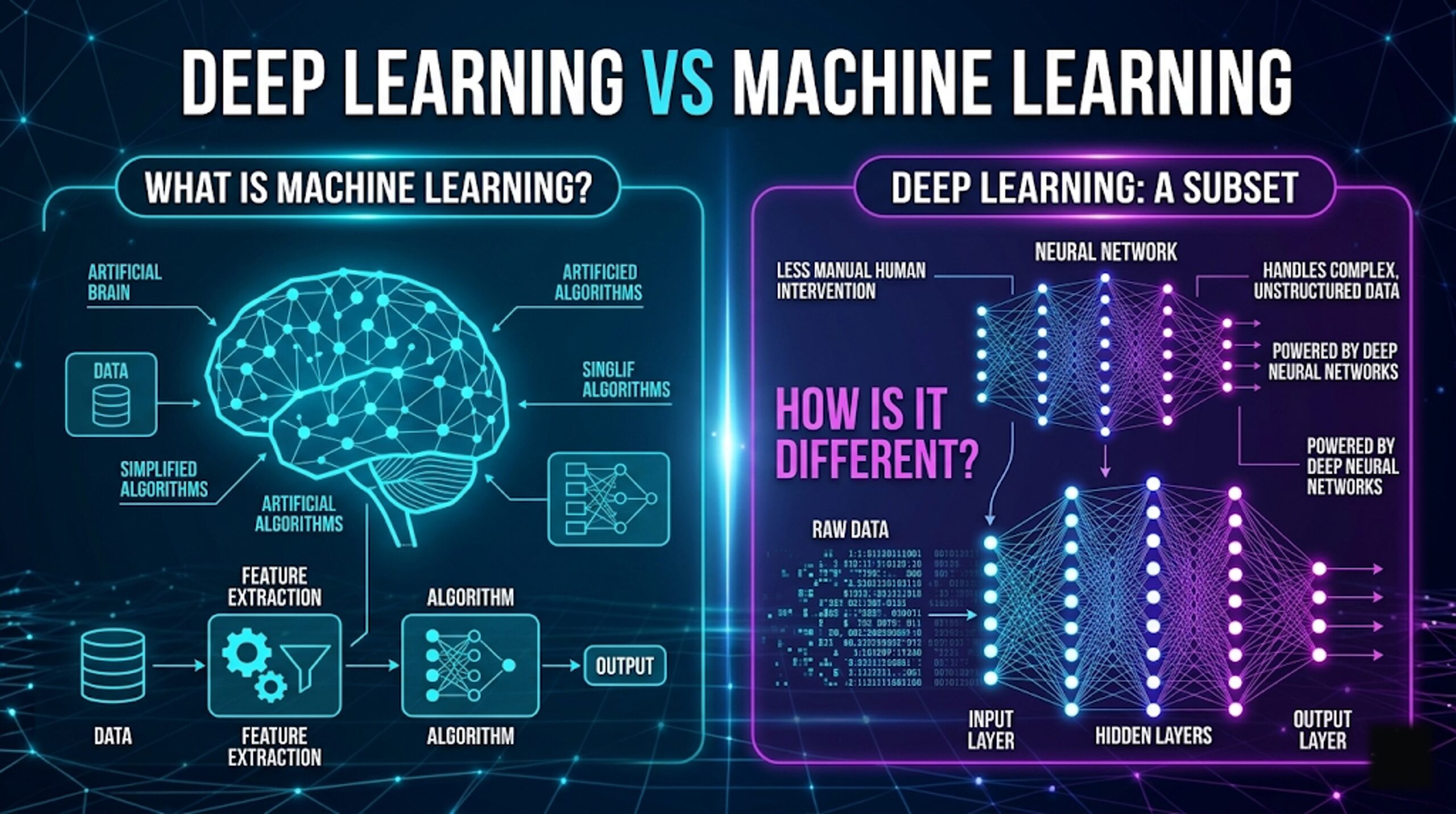
Artificial intelligence is not a single technology. It is a layered system, where each layer builds on the one beneath it, and each one does something the layer before it could not. Most people have heard the terms machine learning and deep learning used interchangeably, often in the same breath as artificial intelligence itself. But these are not the same thing, and understanding the difference between them is one of the most clarifying steps anyone can take when trying to make sense of how modern AI actually works.
The confusion is understandable. Machine learning, deep learning, and artificial intelligence all involve computers learning from data and making decisions. They share a common purpose and a common vocabulary, which makes it easy to treat them as synonyms. But each one represents a distinct level of capability, a different approach to solving problems, and a different set of trade-offs. Knowing where one ends and the other begins is not just academic knowledge. It explains why some AI systems can recognise your face in a photograph but struggle with tasks a child can do effortlessly, and why others can write a full essay but occasionally invent facts that never existed.
The Relationship Between AI, Machine Learning, and Deep Learning
Before comparing machine learning and deep learning directly, it helps to understand how they relate to each other structurally. The easiest way to picture this is as a set of nested circles. Artificial intelligence is the largest circle. It refers to the broad field of building systems that can perform tasks that typically require human intelligence. Inside that circle sits machine learning, a specific approach to building AI that focuses on systems that learn from data rather than following manually written rules. Inside the machine learning circle sits deep learning, a more advanced technique within machine learning that uses a specific type of architecture to handle more complex problems.
In essence, all deep learning is machine learning, and all machine learning is a form of artificial intelligence. But not all machine learning is deep learning, and not all artificial intelligence relies on machine learning. The terms describe different levels of the same broader field, not competing approaches to the same problem.
What Machine Learning Does
Machine learning is a method of building AI systems that learn from data to make predictions or decisions, rather than following a set of fixed instructions written by a programmer. Instead of a developer writing a rule that says “if an email contains these words, mark it as spam,” a machine learning model is trained on thousands of examples of spam and non-spam emails and learns to identify the patterns that distinguish one from the other. The result is a system that can handle new emails it has never seen before and make accurate judgments about them based on what it has learned.
Machine learning works exceptionally well with structured data, information that is organised into clear categories and columns, like the kind found in spreadsheets, databases, and transaction records. A model trained on structured customer data can predict which customers are likely to cancel a subscription. A model trained on financial transaction records can detect unusual spending patterns that suggest fraud. These are tasks where the relevant features of the data are relatively clear, and the model can be trained to recognise them with a manageable amount of data and computing power.
The limitation of traditional machine learning is that it typically requires human involvement in the feature selection process. A data scientist or domain expert needs to identify which variables in the data are most likely to be relevant and present them to the model in a useful form. The model learns from those features, but the selection of what to pay attention to is a human decision. For structured data and well-defined problems, this approach works reliably. For messy, unstructured data like images, audio recordings, or raw text, it becomes much harder to specify the relevant features manually, and the models struggle to perform at the level needed for real-world applications.
What Deep Learning Does Differently
Deep learning addresses exactly the limitation that machine learning runs into with complex, unstructured data. Rather than relying on humans to identify the relevant features before training begins, deep learning models learn those features automatically, directly from the raw data, through a process that involves many layers of interconnected nodes working together.
The word “deep” in deep learning refers to these multiple layers. Each layer in a deep learning network learns to recognise a different level of abstraction in the data. In an image recognition system, for example, the earliest layers might learn to detect basic edges and shapes. The middle layers might combine those edges and shapes into recognisable textures and structures. The deepest layers might combine everything into high-level concepts like “this is a face” or “this is a car.” By the time information reaches the output layer, the network has built up a rich, layered understanding of the input, without a human ever having to specify what to look for.
This ability to learn hierarchical representations automatically is what makes deep learning so powerful for tasks involving images, speech, and language. These are exactly the kinds of problems where the relevant patterns are too complex and too numerous for a human to define in advance. A deep learning model trained on millions of images can learn to identify objects with a level of accuracy that consistently matches or surpasses human performance. A deep learning model trained on vast amounts of text can learn the structure and patterns of human language well enough to generate coherent, contextually appropriate responses. That is the foundation of every major language model in use today, including the ones powering ChatGPT, Claude, and Gemini.
The Differences
The most important practical differences between machine learning and deep learning come down to four areas: the type of data each handles best, the amount of data each requires, how much human involvement is needed, and the computing resources each demands.
Machine learning performs well on structured, clearly organised data and can produce reliable results with relatively small datasets. It requires human input in selecting which features of the data are most relevant, and it can run effectively on standard hardware without specialised infrastructure. When a model makes an error, a human can usually identify what went wrong and adjust the approach.
Deep learning thrives on large volumes of unstructured data such as images, video, audio, and raw text. It requires significantly more data to train effectively, and because it learns its own feature representations automatically, it does not rely on human feature engineering. However, it demands considerably more computing power, typically requiring specialised hardware like graphics processing units to train large models in a reasonable amount of time. Deep learning models are also more difficult to interpret once trained, because the patterns they learn are distributed across millions of internal parameters rather than expressed in rules a human can read and understand.
Neither approach is universally superior. The right choice depends entirely on the problem being solved and the data available. A business predicting customer churn from structured transaction data might get everything it needs from a straightforward machine learning model. A company building a voice assistant or an image recognition system will almost certainly need deep learning to reach the level of performance its users expect.
Deep Learning Changed Everything
For most of the history of artificial intelligence, machine learning was the dominant approach, and it produced genuinely useful results in many domains. What changed was the convergence of two things: the explosion of digital data produced by the internet, and the development of computing infrastructure powerful enough to train large neural networks at scale. When both of those conditions were met, deep learning went from a promising academic idea to the engine of a technological revolution.
Every major AI capability that has captured public attention in recent years, from image generation and voice recognition to language models and real-time translation, runs on deep learning. The chatbot answering customer queries, the recommendation engine deciding what content to surface next, the medical imaging tool flagging anomalies for a radiologist to review: all of these are deep learning systems trained on enormous datasets to perform tasks that traditional machine learning could not handle at the required level of accuracy or scale.
Understanding this is not just useful for developers or data scientists. It is useful for anyone trying to make sense of why AI is suddenly capable of things it was not capable of five years ago, and what that means for the industries and workflows that are being changed by it.
Uniqueness in Difference
Machine learning and deep learning are not competing technologies. They are complementary tools that sit at different levels of the same field, each suited to different kinds of problems. Machine learning remains a practical and powerful approach for structured data and well-defined tasks. Deep learning is the force behind the AI breakthroughs that are reshaping how people work, create, and communicate in 2026.
Knowing the difference between the two does not require a technical background. It only requires understanding one core idea: machine learning teaches a system what to look for, while deep learning lets the system figure out what to look for on its own. That single distinction explains more about the current state of artificial intelligence than almost any other concept in the field.