
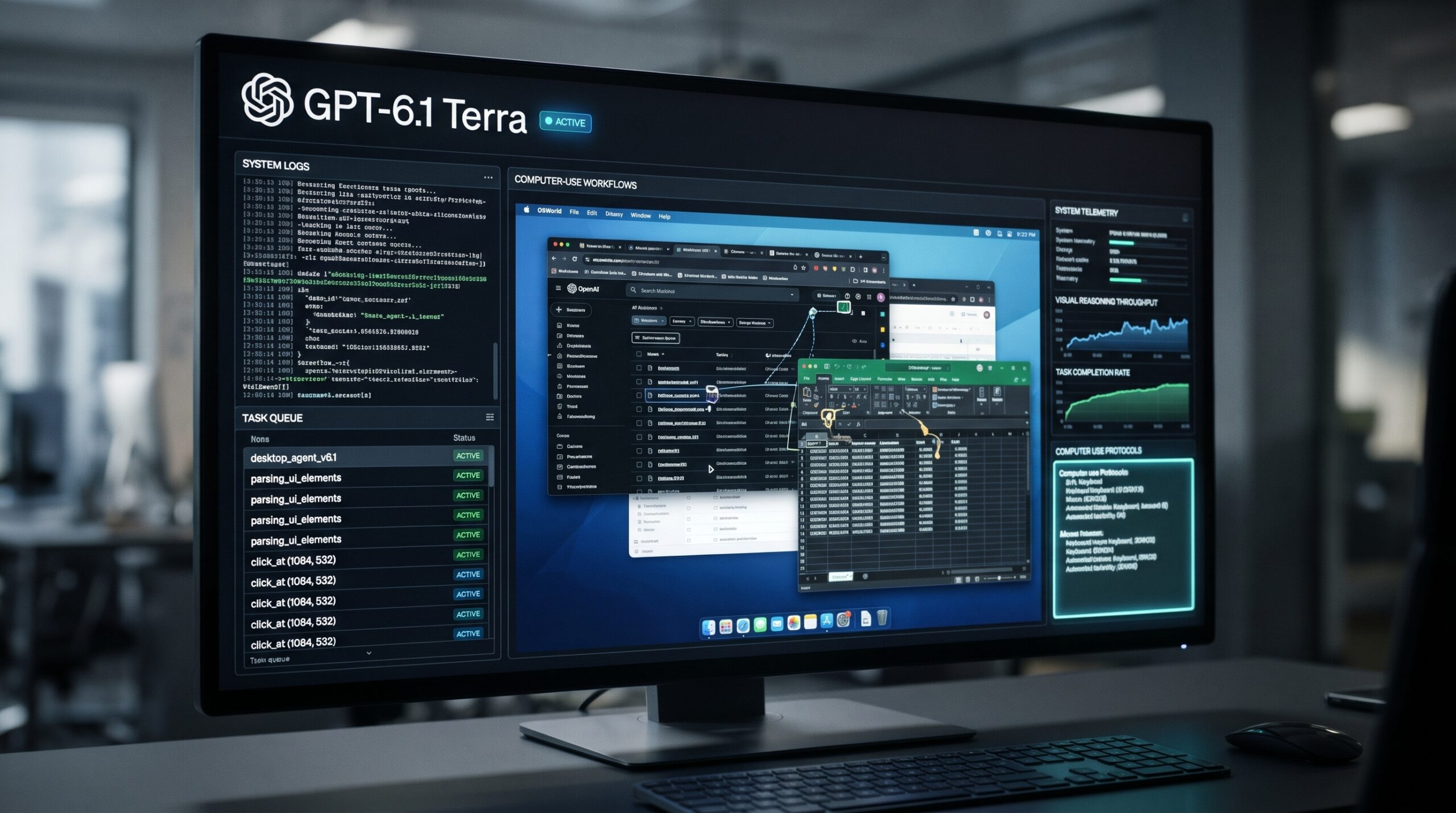
OpenAI has introduced GPT-6.1 Terra, a new artificial intelligence model designed to understand visual information, operate supported computer applications and complete routine professional tasks at a lower cost.
Announced on October 26, 2026, GPT-6.1 Terra combines visual reasoning, computer-use capabilities and writing. OpenAI says the model can support tasks such as filling out forms, interpreting technical drawings, editing videos and transferring information from invoices into accounting software.
The launch reflects a broader shift in AI development from systems that primarily generate text to models that can interact with software and carry out multi-step workflows.
OpenAI says GPT-6.1 Terra’s standard API prices are 50% lower than those of GPT-5.6 Terra and GPT-6.1 Sol, making it a more affordable option for developers building applications that rely on repeated computer-based tasks.
What GPT-6.1 Terra can do
GPT-6.1 Terra is designed to interpret what appears on a screen and take actions through supported computer-use tools.
Instead of simply explaining how to complete a task, an AI agent using the model can interact with application interfaces to carry out parts of the workflow.
For example, a business could use it to read incoming invoices, extract relevant information and enter the details into accounting software. Another workflow could involve reviewing campaign images, checking text placement and organising edits.
The model can also assist with interpreting technical drawings, matching product images to catalogue entries, filling out forms and drafting or revising documents.
These capabilities could help businesses automate repetitive work that currently requires employees to move information between different applications.
However, computer use depends on the tools and permissions available in the environment where the model operates. The launch does not mean Terra can automatically access every application or independently complete every task without setup or supervision.
OpenAI says the model is cheaper and faster
OpenAI says GPT-6.1 Terra’s standard API pricing is 50% lower than that of GPT-5.6 Terra and GPT-6.1 Sol. Its published rates are $1 per million input tokens and $5 per million output tokens, with separate rates for cached inputs and other pricing options.
The company is also positioning Terra as an efficient model for computer-use workflows.
According to OpenAI, GPT-6.1 Terra scored 15 percentage points higher than GPT-5.6 Terra on the Agents’ Last Exam benchmark at medium reasoning effort, while costing about one-third as much for the evaluated tasks.
OpenAI also reported that Terra completed tasks more than three times faster than GPT-6 Astra and GPT-6.1 Sol in its comparison.
These results are based on OpenAI’s stated evaluations and should not be treated as a guarantee that Terra will be faster or cheaper for every real-world task. Performance and costs can vary depending on the complexity of a workflow, the number of tool calls required and the reasoning settings used.
The lower pricing could nevertheless be relevant to developers running AI agents at scale, where small differences in the cost of each task can add up across thousands of operations.
Designed for a full day of professional work
OpenAI describes Terra as a model for the communication and computer-based tasks that fill a typical workday.
That includes work involving documents, visual materials, forms and software interfaces rather than only traditional question-and-answer conversations.
The model can combine screen understanding with writing and application interaction. This makes it suitable for defined workflows in which an agent must inspect information, make decisions and take a series of actions to reach a specific result.
OpenAI’s announcement also highlights improvements in factual accuracy and coding compared with its previous Terra model. The company reported a lower error rate on its internal benchmark of difficult prompts and stronger performance on Terminal-Bench 4.0, which evaluates coding tasks performed through a command-line interface.
Terra is not positioned as the best choice for every complex task, however. OpenAI recommends its more capable models, including GPT-6.1 Sol and GPT-6 Astra, for demanding reasoning and complex coding work.
Availability and access
GPT-6.1 Terra is available through ChatGPT Work and Codex for eligible Plus, Pro, Enterprise and Edu users. Developers can also access it through the OpenAI API using the model identifier gpt-6.1-terra.
It is not available in regular ChatGPT conversations, according to OpenAI’s product documentation. Access through organisational plans may also depend on workspace settings and administrator controls.
For developers, the API offers a way to integrate Terra into applications that need visual reasoning or computer-use functionality. Businesses can also explore the model through supported Work and Codex experiences, subject to the relevant setup and permissions.
What the launch means for AI automation
GPT-6.1 Terra arrives as companies explore AI agents that can do more than draft messages or answer questions.
An agent capable of navigating supported software can potentially reduce the manual work involved in transferring information, reviewing visual materials and completing routine digital processes.
Lower model costs could make some of these workflows more practical, particularly when they run frequently. However, businesses still need to account for setup, tool usage, errors, access controls and the need to verify important actions.
Computer-use systems also require safeguards because mistakes in an application can have consequences beyond an inaccurate answer. Tasks involving financial records, customer data or irreversible changes may require additional checks and human approval.
The important development is not that AI can now perform every job throughout an entire workday without oversight. It is that OpenAI is making a model specifically designed for screen-based work available at a lower price, with the aim of making more computer-based tasks practical to automate.
As AI agents become more capable, their usefulness will depend not only on what they can reason about, but also on how reliably and affordably they can turn that reasoning into action.
Read also: How Ledig uses stablecoins to help African businesses manage FX risk