
AI is no longer a buzzword. It is the infrastructure the modern world is quietly being built on, and whether you work in tech, content, business, or education, it is already reshaping how work gets done. Most people, however, are still only scratching the surface of what artificial intelligence can actually do. They try one tool, use it for basic tasks, and assume that is the full picture. Meanwhile, entire industries are being rebuilt by AI applications that most people have never taken the time to explore.
If staying relevant matters to you, whether as a business owner, a creator, a writer or a professional in any field, understanding what AI can actually do in 2026 is no longer optional. This article breaks down the seven most important AI applications making a real impact right now. Real categories of AI are doing real things that are changing the way people work, create, and communicate.
What Is an AI Application?
An AI application is any software or platform that utilises artificial intelligence to perform tasks that would normally require human intelligence, such as understanding language, generating images, writing code, analysing data, or making decisions based on patterns. Think of it as giving a computer the ability to think, learn, and respond, rather than just following a rigid set of instructions it was pre-programmed with.
In 2026, AI applications have moved far beyond the experimental stage. They are embedded in design tools, search engines, writing platforms, development environments, and business workflows. The question is no longer whether AI is relevant; it is whether AI is relevant. The question is which AI application addresses your biggest need first.
Here are the top seven.
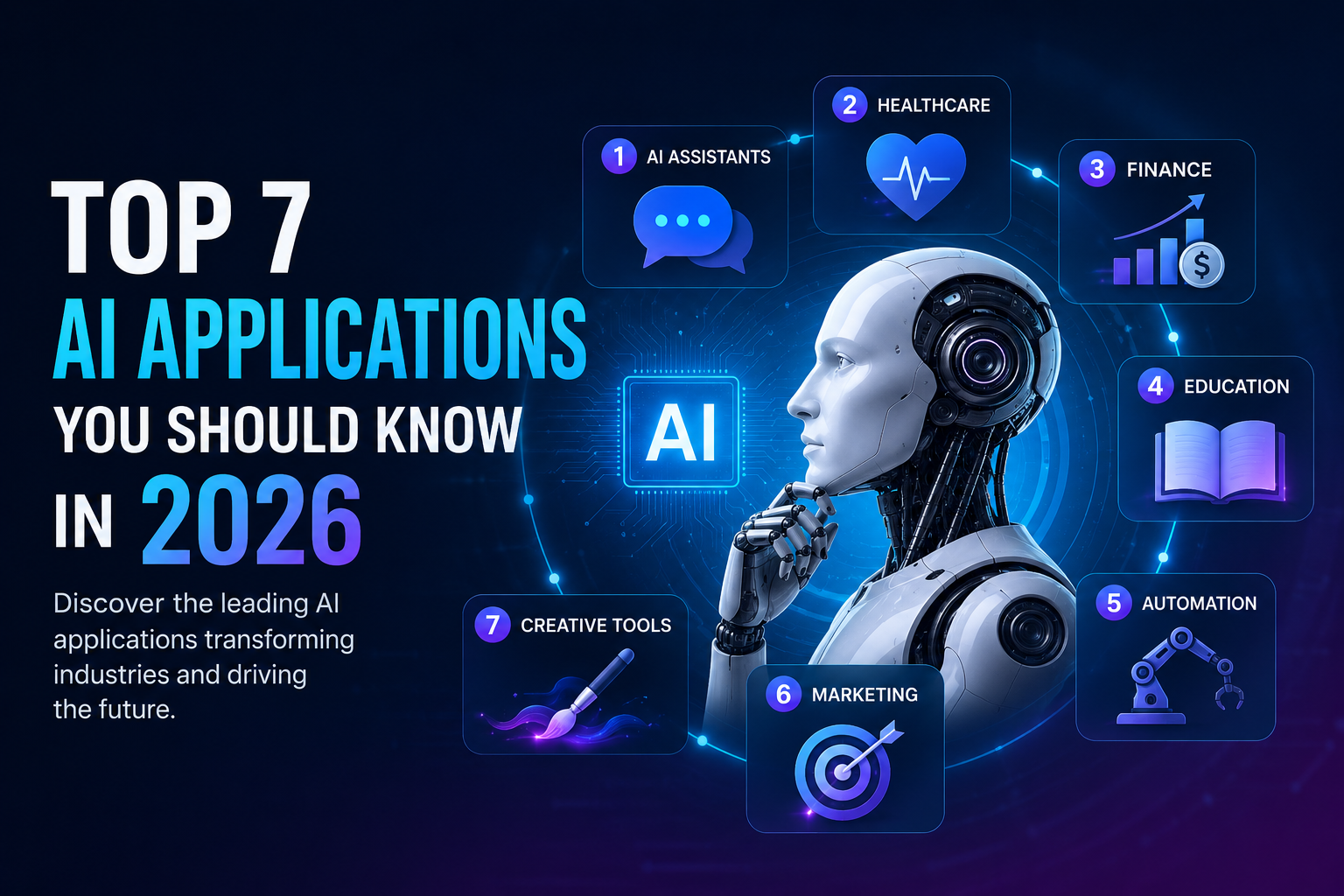
Top 7 AI Applications You Should Know in 2026
- Conversational AI (for thinking, writing, and problem-solving)
- AI Image Generation (for creating visuals from scratch)
- AI Coding Assistants (for building and debugging software)
- AI Video Generation (for producing video content at scale)
- AI Voice and Audio Tools (for realistic speech and audio editing)
- AI Agents and Automation (for running tasks on autopilot)
- AI Search and Research (for finding information faster and smarter)
1. Conversational AI (for thinking, writing, and problem-solving)
This is where most people begin their AI journey, and it is where the most immediate value tends to show up. Conversational AI refers to large language models that can understand questions, hold a natural dialogue, and assist with an almost unlimited range of tasks, from writing and editing to research, strategy, planning, and problem-solving. The most widely used examples in 2026 are ChatGPT by OpenAI, Claude by Anthropic, and Gemini by Google.
What separates 2026’s conversational AI from what existed even two years ago is the depth of context and the quality of reasoning. These tools can now hold long, detailed, multi-step conversations without losing the thread. A writer can paste a rough draft and receive a sharp, thoughtful edit with explanations. A business owner can describe a challenge in plain language and work through a structured solution in minutes. A student can explore a complex topic through dialogue rather than searching through dozens of links. The versatility is what makes this category so foundational, it is not built for one use case, it is built for any use case.
Conversational AI has become the fastest way to multiply output without multiplying hours. Regardless of profession or industry, it is one of the most accessible and immediately useful AI applications available today.
2. AI Image Generation (for creating visuals from scratch)
Not long ago, producing a high-quality custom image required either hiring a professional designer or investing significant time in tools like Photoshop. AI image generation has changed that equation entirely. Tools like Midjourney, DALL-E 3, and Adobe Firefly can now transform a plain text description into a polished, professional-looking image in seconds. A user describes what they want to see, the subject, the style, the mood, the lighting, and the AI renders it.
What has improved most dramatically is precision. Earlier versions of these tools produced results that were often close but rarely exact. In 2026, the models are sophisticated enough to interpret nuance, specific colour palettes, distinct art styles, and fine compositional details. Adobe Firefly stands out in particular because it is built directly into Adobe’s existing creative suite, allowing designers to bring AI generation into their established Photoshop and Illustrator workflows without disruption. For marketers, content creators, bloggers, and brand builders, AI image generation has effectively removed one of the biggest creative bottlenecks, the cost and time of producing original visuals.
Visual content drives engagement across every major platform. AI image generation means that individuals and small teams can now produce scroll-stopping visuals at a fraction of the traditional cost and timeline.
3. AI Coding Assistants (for building and debugging software)
Here is something that would have sounded impossible just five years ago: a person with no programming background sitting down and building a working web application, without writing a single line of code themselves. That is what AI coding assistants have made possible, and the implications for both developers and non-developers are enormous.
Tools like GitHubCopilot, Cursor, and Claude Code act as intelligent programming partners embedded directly into the development environment. They suggest code as a developer types, explain what blocks of code do in plain English, automatically identify and fix bugs, and can even generate entire features from a plain-language description. Cursor, one of the most popular examples right now, is a code editor with AI models built directly into the interface. A developer can highlight an error, type a simple instruction, and watch the AI diagnose the problem and rewrite the affected section in real time. Beyond writing code, these tools are also changing how teams handle documentation, code reviews, and onboarding. For non-developers, they have lowered the barrier to building so significantly that the line between “technical” and “non-technical” is becoming less meaningful by the month.
AI coding assistants give developers the ability to work two to three times faster, and give non-developers the power to build things that were previously out of reach without a technical co-founder or a hired engineer.
4. AI Video Generation (for producing video content at scale)
Video has been the dominant content format online for years, but producing it well has always demanded significant resources, cameras, lighting, editing software, post-production time, and often an entire team. AI video generation is dismantling those requirements one by one. Tools like Sora by OpenAI, Kling AI, and Runway can now produce realistic video clips directly from a text prompt or a reference image. A user describes a scene in plain language, and the AI renders it as a video, no filming, no editing suite, no production crew required.
The applications are broader than most people expect. Brands are already building full advertising campaigns around AI-generated video because the speed and cost advantages are impossible to ignore. E-learning platforms are using it to produce explainer content at scale. Marketers and creators are generating short-form clips for social media without ever touching a camera. Kling AI, one of the standout platforms in this space, functions as a complete AI creative studio, handling video generation, voiceovers, and final output all within the same interface. The outputs are not yet perfect across every use case, but the pace of improvement is extraordinary. What felt like science fiction in 2023 is a practical production tool in 2026.
AI video generation has put the equivalent of a production studio into a browser tab, making high-quality video content accessible to individuals and small teams who could never afford it before.
5. AI Voice and Audio Tools (for realistic speech and audio editing)
Text-to-speech technology has existed for years, but for most of that time, it was easy to detect, robotic, flat, and unconvincing. That era has ended. AI voice tools like ElevenLabs have reached a level of realism that is genuinely difficult to distinguish from a real human speaker. Voices can be cloned, narrations can be generated in dozens of languages, and tone, emotion, and pacing can all be adjusted through simple text input. The result is audio content that sounds natural, warm, and professional, produced in minutes rather than hours.
The use cases are expanding rapidly. Podcasters are using AI voices to produce additional content without requiring recording sessions. Online course creators are building fully narrated lessons in a fraction of the time it would take to record them manually. Businesses are powering customer support systems with AI voices that communicate clearly and naturally. On the audio editing side, tools like LALAL.AI address one of the most persistent frustrations for anyone who records audio, background noise. By uploading a recording, the AI separates and removes ambient sounds without degrading the quality of the speaker’s voice, making professional-sounding audio achievable from almost any environment.
Content that once required a professional recording studio and a voice actor can now be produced by a single person, on a laptop, in an afternoon.
6. AI Agents and Automation (for running tasks on autopilot)
This is the category most people are still underestimating, and it is arguably the most transformative on this list. An AI agent is not simply a tool that answers questions, it is an AI that can take actions. It can browse the web, send emails, update spreadsheets, pull data, and complete complex multi-step tasks from start to finish, without a person needing to supervise each step. The distinction matters: a chatbot responds, an agent executes.
Gumloop is one of the clearest examples of this right now. It allows users to connect AI models like Claude or ChatGPT to their existing tools and build a fully automated workflows, no coding required. A business could set up an agent that monitors competitor websites, extracts pricing data, organises it into a spreadsheet, and delivers a summary every Monday morning, all without anyone touching a keyboard. Zapier, which pioneered workflow automation before the AI era, has added a sophisticated AI layer to its platform. And tools liken8n give more technically inclined teams the flexibility to build complex custom automations. The key shift in 2026 is that agents are becoming better at chaining tasks adaptively, using the result of one step to inform the next, which is what makes them genuinely powerful rather than just convenient shortcuts.
Any task that is performed manually regularly is a candidate for AI automation. The time recovered from removing repetitive work is one of the most tangible returns AI can deliver.
7. AI Search and Research (for finding information faster and smarter)
Traditional search engines transformed how people find information. AI-powered search is transforming it again, and the difference is significant. Where traditional search returns a list of links and leaves the reading to the user, AI search reads the sources, synthesises the information, and delivers a direct answer, with citations. The result is research that used to take an hour but is now taking four minutes.
Perplexity AI is the most widely recognised example of this category. Ask it a research question and it queries multiple sources across the web, synthesises the content, and presents a clear, sourced response. There is no sorting through ten browser tabs or evaluating which result to trust. Google has entered this space aggressively as well with its AI Mode, a search experience that generates direct answers with sourcing rather than simply ranking pages for the user to navigate. What makes AI search particularly powerful beyond speed is the ability to go deeper in real time, asking follow-up questions, requesting comparisons between sources, or narrowing down to a specific angle of a topic. For writers, researchers, journalists, and anyone who needs to stay current in a fast-moving space, this is one of the most practical AI applications available.
Information overload is one of the defining problems of the Internet age. AI search cuts through the noise and puts the answer directly in front of the person looking for it.
Which AI Application Should You Start With?
That depends on what problem needs solving first. A writer or content creator will get the most immediate value from conversational AI, tools like Claude and ChatGPT can make work faster and sharper almost from the first session. Someone building a social media presence should look at AI image generation and video tools, both of which remove the production barriers that used to require either a big team or a big budget. A business owner dealing with repetitive operational tasks should explore AI agents and automation, the time savings tend to be significant and fast to see.
What matters most is not trying to adopt all seven categories at once. It is understanding what each one does, identifying which one maps directly to a current need, and starting there. AI in 2026 is not about replacing human skill or creativity. It is about extending both, doing more with the same time, producing better output with fewer resources, and staying capable in a world that is moving faster than ever. The only real mistake at this point is waiting too long to begin.
Read also: Strategy adds 535 BTC, makes total holdings above 818,000 Bitcoin