
Ethereum co-founder Vitalik Buterin has voiced support for Moonshot AI’s decision to reduce the offensive cybersecurity capabilities of its latest artificial intelligence model, Kimi K3.1 Pro, arguing that limiting dangerous AI capabilities is preferable to restricting access based on users’ identities.
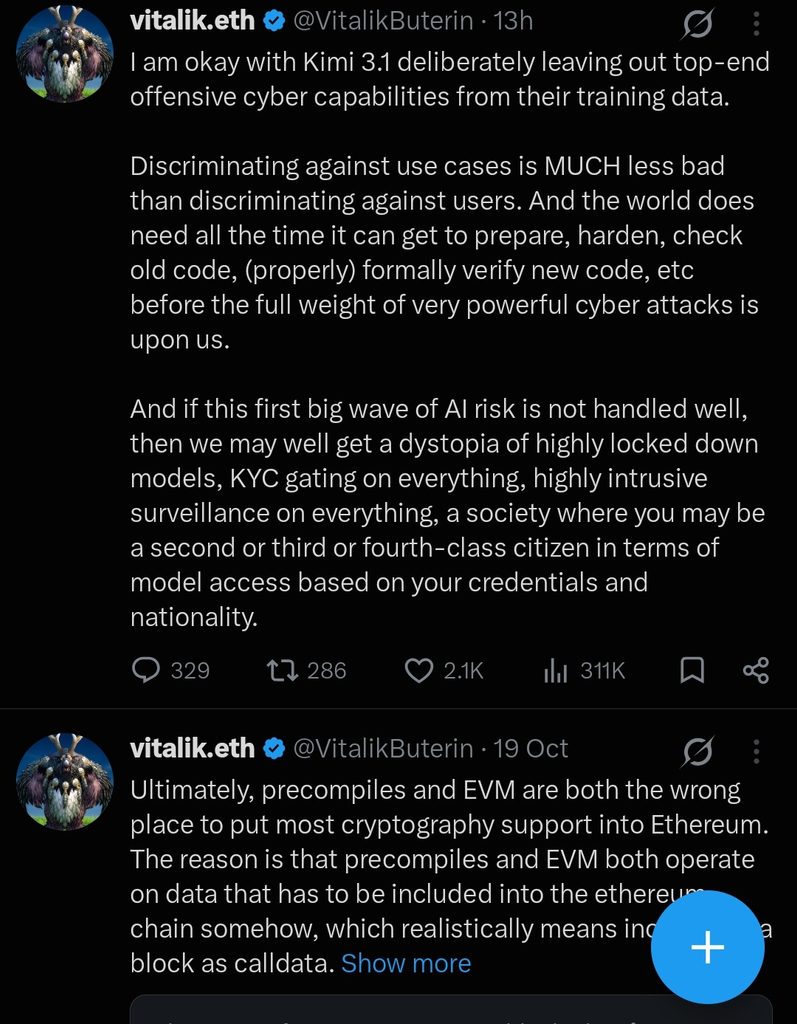
In a post on X on October 26, Buterin warned that mishandling AI-related risks could lead to a future where powerful AI models are locked behind mandatory identity checks, intrusive surveillance and access rules based on users’ credentials or nationality.
His comments followed Moonshot AI’s decision to remove cyber-related data from the training process for Kimi K3.1 Pro ahead of a planned public release of the model’s weights on November 4, 2026.
The move highlights a growing debate in the AI industry: how developers can reduce the risks of advanced AI systems without making access to powerful tools dependent on identity, location or status.
Why Moonshot AI reduced Kimi’s hacking capabilities
Moonshot AI, the Chinese company behind the Kimi model family, introduced Kimi K3.1 Pro as its latest open-weight AI model. The company says it removed cyber-related material from the model’s training corpus and reinforcement-learning environments while retaining its general coding capabilities.
The aim is to reduce the model’s ability to carry out sophisticated offensive cyber activities, particularly tasks involving the discovery and exploitation of software vulnerabilities.
The company said it did not want to release open model weights that would push the limits of offensive cyber capabilities.
Moonshot’s internal benchmark results suggest the changes reduced the model’s performance on certain cybersecurity tasks. The company reported that the restricted model scored 81.0% on its internal exploit benchmark, compared with 90.5% for a similar version developed without the same risk-reduction measures.
The benchmark involved identifying and exploiting software vulnerabilities in a controlled environment. However, the results have not been independently verified, so they should be treated as company-reported figures rather than independently established findings.
The decision comes amid concerns that increasingly capable AI systems could make sophisticated cyberattacks easier and cheaper to carry out. AI models can help users write code, analyse software and automate complex tasks, capabilities that can be used for legitimate security research but may also be misused.
Moonshot’s approach attempts to preserve useful coding capabilities while reducing some of the model’s potential for offensive cyber activity.
Why Vitalik Buterin supports the approach
Buterin’s argument centres on the difference between restricting what an AI system can do and restricting who can use it.
“I am okay with Kimi 3.1 deliberately leaving out top-end offensive cyber capabilities from their training data,” he wrote.
He added that “discriminating against use cases is MUCH less bad than discriminating against users.”
In other words, Buterin favours safeguards that target potentially dangerous activities rather than rules that determine access based on a person’s identity.
For example, an AI developer could limit a model’s ability to assist with sophisticated cyberattacks while allowing people to use it for writing, research, software development and other legitimate tasks.
Identity-based restrictions would take a different approach. They could require users to prove who they are or meet particular eligibility conditions before accessing advanced AI systems.
Buterin’s concern is that if AI safety measures rely too heavily on controlling users rather than reducing specific risks, the result could be a more restrictive digital environment.
He also argued that society needs time to prepare for increasingly powerful AI systems. Developers must strengthen existing software, review older code and use formal verification methods to improve the reliability and security of new systems.
Reducing certain AI capabilities could provide more time for those defences to improve.
Buterin warns of locked-down AI and mandatory KYC
Buterin warned that if the first major wave of AI-related risks is handled poorly, governments and companies could respond by imposing broad restrictions on access to powerful models.
He described a possible future involving highly locked-down AI systems, know-your-customer (KYC) requirements across services and intrusive surveillance.
Under such a system, access to AI could depend on a person’s credentials, identity or nationality. Users might receive different levels of access based on their perceived eligibility rather than the tasks they want to perform.
KYC checks are commonly used in financial services to verify customers’ identities and help prevent activities such as money laundering. Buterin’s warning concerns the possibility of similar identity requirements becoming widespread across AI services.
Such a development could affect people who rely on AI for education, research, software development and other legitimate uses, particularly if access rules become difficult to satisfy or vary between jurisdictions.
However, Buterin was warning about a potential outcome, not announcing that mandatory KYC requirements for AI access are already in place across the industry.
His position raises a broader policy question: can AI companies manage serious risks without creating systems in which access to useful technology depends on a person’s identity or official status?
Open-weight AI makes safety harder to enforce
Moonshot’s decision also highlights a challenge with open-weight AI models.
Unlike a service that runs entirely on a company’s servers, an open-weight model allows developers to obtain the model files and run the system on their own infrastructure, subject to the applicable release terms.
This can give researchers and organisations more control over how they use AI. It can also help security teams inspect code, identify weaknesses and protect systems that might otherwise receive limited attention.
But once model weights are distributed, the original developer has less direct control over how the model is deployed. It becomes harder to monitor every use, enforce restrictions centrally or update safeguards for all copies.
Moonshot plans to publish Kimi K3.1 Pro’s weights on November 4, 2026. Its decision to reduce offensive cyber capabilities before that release reflects an attempt to address potential risks before the model is distributed more widely.
The approach does not eliminate every possibility of misuse, nor does it guarantee that all harmful capabilities have been removed. It does, however, demonstrate one way developers can try to reduce risk at the model-training stage rather than relying entirely on access restrictions after release.
What this means for AI developers and cybersecurity
The debate has implications for AI developers, software companies and cybersecurity professionals.
AI can support defensive work by helping security researchers examine software, identify vulnerabilities and improve code. The same capabilities can also assist malicious actors, especially when models can automate multiple steps of a technical task.
Reducing the most dangerous capabilities could help limit some of those risks. At the same time, overly broad restrictions could prevent legitimate users from accessing tools they need for research, development and security work.
There is no single safeguard that resolves these competing concerns. Training choices, evaluations, deployment controls and stronger software security can all play a role, but each approach has limitations.
Moonshot’s reported benchmark results provide one measure of the trade-off it made with Kimi K3.1 Pro. Independent testing will be important for determining how effective those measures are in practice.
Buterin’s warning adds another dimension to the discussion: safety measures should be assessed not only by how much risk they reduce, but also by whether they create unnecessary barriers for legitimate users.
The challenge for the AI industry is to make increasingly capable systems safer without turning access to them into a privilege reserved for people who meet particular identity or status requirements.
As more powerful AI models become available, the decisions developers make today could help shape both the security of digital systems and the freedom people have to use AI in the future.