
Have you ever played checkers? The kind of game where every move you make either costs you a piece or sets you up to take one, where the deeper you play, the more you start to see the board differently?
That game didn’t just appear on a screen one day. In 1959, a computer scientist named Arthur Samuel deliberately chose it as his testing ground. The thought process behind his choice was simple but radical: checkers had enough complexity to be challenging, but enough structure to be measurable. He wanted to know if a machine could study its own mistakes, adjust its strategy across thousands of games, and get better, without anyone telling it how. The term he used to describe what the program was doing became the foundation of one of the most consequential technologies alive today: machine learning.
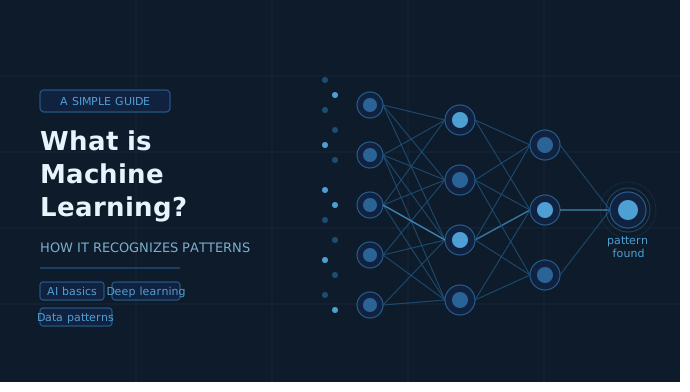
What is Machine Learning?
Machine learning is a method of building computer systems that improve through experience rather than explicit instruction.
Traditional software works on fixed rules. A developer tells the computer exactly what to do. Machine learning flips that model. Instead of writing rules, you feed the system data and let it discover the rules on its own.
Take for example; You have a junior analyst in training. You don’t give them every answer. You give them examples, guide them, and over time, they start spotting trends handling tasks independently. That is what machine learning does. It finds structure in data, and uses that structure to make decisions on new data it has never seen before.
Data is everything
Machine learning systems are only as good as the data they are trained on. Data is the raw material. Without it, nothing works.
There are three key elements in any machine learning setup:
- Data: The information the system learns from
- Model: The algorithm or framework that processes the data
- Training: The process of teaching the model using data
If the data is messy, biased, or incomplete, the model will produce flawed results. This is why serious practitioners spend more time cleaning data than building models.
How a Machine Recognizes Patterns
A machine does not see the world the way a human does. It sees numbers. Every piece of information, whether a photo, a sentence, or a bank transaction, gets converted into numerical data before the algorithm can work with it. A photograph becomes a grid of pixel values. A sentence becomes a sequence of numerical codes. A transaction becomes a row of figures: amount, time, location, merchant type. From that point, everything is mathematics.
Here is what the recognition process looks like, step by step.
- The machine starts by guessing. When training begins, the model knows nothing. It looks at the first example, say a bank transaction, and makes a random prediction. Fraud or not fraud. It will almost certainly be wrong. That is fine, that is expected, that is the point.
- It then checks how wrong it was. The training data already has the correct answers attached. The model compares its guess to the real answer and measures the gap between them. The bigger the gap, the more it has to adjust.
- It adjusts, and tries again. Based on how wrong it was, the model makes small internal corrections, tiny shifts in how it weighs different pieces of information. Then it moves to the next example and repeats the same process. Guess. Measure. Adjust. Move on.
- It does this thousands of times. By the time the model has worked through the entire dataset, those small adjustments have added up into something meaningful. The model has started to notice that certain combinations of information keep showing up together in fraudulent transactions: a large amount, an unusual location, an odd hour. It is not memorizing those specific transactions. It is learning the relationship between those details and the outcome. That relationship is the pattern.
- It then meets data it has never seen before. This is the real test. A well-trained model takes that learned pattern and applies it accurately to new examples it was never trained on. That is what makes it useful in the real world. It is not recalling something it memorized. It is recognizing something it learned.
That full cycle, guess, measure the error, adjust, repeat, and then apply to new situations, is the engine behind every machine learning system that recognizes patterns, whether it is reading a chest scan, filtering spam, or ranking content in a feed.
A real-world analogy
Imagine teaching a child to recognize dogs.
You show them many pictures:
- Different breeds
- Different sizes
- Different colors
Over time, the child learns what features define a dog.
Machine learning works the same way,except it uses numbers instead of intuition.Pattern recognition is the engine behind modern digital experiences.
It enables:
- Fraud detection in financial systems
- Personalized recommendations in media platforms
- Predictive analytics in healthcare
- Risk assessment in insurance
In a data-driven world, the ability to detect patterns is a competitive advantage.
Organizations that get this right don’t just react—they anticipate.
The Three Ways Machines Learn
Machine learning is not one single method. There are three distinct approaches, each designed for a different kind of problem.
- Supervised Learning: trains a model on data that already has correct answers attached. Every example comes labeled. The model studies those labels, learns which details correspond to which outcomes, and uses that knowledge to make predictions on new data. Most tools people use daily, spam filters, image classifiers, disease detection systems, are built this way.
- Unsupervised Learning: works without labels. The model receives raw data and its job is simply to find structure within it. No one defines the categories in advance. The algorithm groups similar data points together and surfaces patterns that were not visible before. Marketers use this to understand customer behavior. Researchers use it to find similarities between genes. The machine finds the pattern, the human decides what it means.
- Reinforcement Learning: is different from both. Here, the model learns through trial, error, and feedback. It takes an action, receives a signal telling it whether that action helped or hurt, and adjusts its behavior over many attempts. The goal is to get better at producing good outcomes over time. This is how AI learns to play complex games, manage logistics systems, and operate robotic equipment, not by studying examples, but by doing, failing, and improving.
Why Machines Keep Getting Better
Machine learning is not static. The more data a model is exposed to, the sharper its pattern recognition becomes. An early speech recognition model might struggle badly with accents or background noise. As it processes more audio, it encounters more variation and updates its understanding to account for it. Its predictions become more accurate. Its errors become less frequent.
This is why the largest technology companies invest heavily in collecting data. The data is not a side effect of their products, it is the raw material that keeps their systems improving. More data means better patterns, better patterns mean better predictions, and better predictions mean better products.
Pattern recognition through machine learning is running quietly across nearly every industry.
In healthcare, models trained on thousands of medical scans are catching early-stage tumors with accuracy that rivals experienced radiologists. In agriculture, aerial imagery combined with machine learning is detecting crop disease before it spreads across an entire field. In finance, fraud detection systems flag suspicious transactions in real time, often before the payment even processes.
In content and media, machine learning decides what gets shown, what gets recommended, and what gets ranked. For anyone working online, understanding how these systems make decisions is no longer background knowledge. It is working knowledge.
Powerful, But Not Perfect
Machine learning is powerful, but it is not neutral. These systems learn from historical data, and if that data carries bias, the model will learn and repeat it. A hiring algorithm trained on decades of biased employment decisions may disadvantage certain groups, not because anyone programmed it to, but because the pattern in the data told it to.
This is one of the most active conversations in artificial intelligence right now. A machine’s pattern recognition is only ever as reliable as the data it learned from. The technology does not create bias, it reflects it back at scale.
What Samuel demonstrated in 1959 with a checkerboard still holds more than six decades later: given enough examples, a machine can learn what no human ever had to teach it explicitly. That capability, scaled to the volume of data the modern world produces every second, is what makes machine learning one of the defining technologies of this era. The computers did not get smarter overnight. They got better data, and they have been learning from it ever since.
Read also: Parallel Web Systems hits $2B valuation as AI agent demand grows