
Imagine receiving your salary in digital dollars, sending money to family in another country and paying for groceries with the same balance. You do not need to visit an exchange or withdraw the money into a traditional bank account before using it.
That is the financial experience miPlata is working to create. The fintech platform combines digital dollar accounts, international money transfers and Visa debit cards, with a new feature allowing eligible users to spend USDC balances through a prepaid card.
For a company targeting Latino communities in the United States and Latin America, the idea addresses a familiar problem: people who earn or receive money across borders often need several financial services to manage, transfer and spend their funds. miPlata wants to bring more of those activities into one application, with stablecoins providing another way to hold and access digital dollars.
Bringing digital dollars into one account
miPlata describes itself as a financial technology platform built to help people receive, save, send and spend US dollars across borders. The company focuses on people who may face difficulties accessing traditional banking services, particularly members of Latino communities living and working in the United States. Its account-opening process is designed to accommodate different forms of government-issued identification, including passports, national identity cards and certain consular documents.
This is significant for people who may not have a US Social Security number or Individual Taxpayer Identification Number. According to the company, eligible users can open accounts without either document, provided they meet its identification and verification requirements.
Once approved, users can access digital dollar accounts, receive payments, transfer funds to other miPlata users and use virtual or physical Visa debit cards.
The platform also provides global banking details, including account information for receiving eligible payments. Users can fund their accounts through supported methods such as direct deposits and linked US bank accounts.
Rather than positioning itself solely as a remittance application, miPlata is attempting to bring several everyday financial activities into one place.
However, miPlata is a financial technology company, not a bank. Its website identifies Lead Bank as the issuing institution behind its prepaid Visa card, while Bridge Ventures LLC serves as the programme manager. These partnerships are important because the company relies on established financial infrastructure to provide services to its customers.
How miPlata is using stablecoins
One of the more interesting developments in miPlata’s product offering is its integration of stablecoins, particularly USDC.
Stablecoins are cryptocurrencies designed to maintain a relatively stable value against another asset, usually a fiat currency such as the US dollar. Unlike Bitcoin, whose market price can fluctuate significantly, dollar-backed stablecoins are designed to maintain a value close to one US dollar.
USDC, issued by Circle, is one of the most widely used dollar-linked stablecoins. It operates across multiple blockchain networks, allowing users and businesses to transfer digital dollars through supported blockchain infrastructure.
For people who receive money internationally, stablecoins can provide an alternative way to hold and transfer dollar-denominated value. They can also reduce dependence on some conventional banking processes, although users still need reliable services to convert digital assets into local currencies or access them through payment systems.
miPlata’s approach is to make these digital dollars part of a familiar financial account rather than requiring users to navigate a separate cryptocurrency wallet and exchange. The platform’s recent Visa card launch takes this approach further by connecting USDC balances with a widely accepted payment network.
Spending USDC through a Visa card
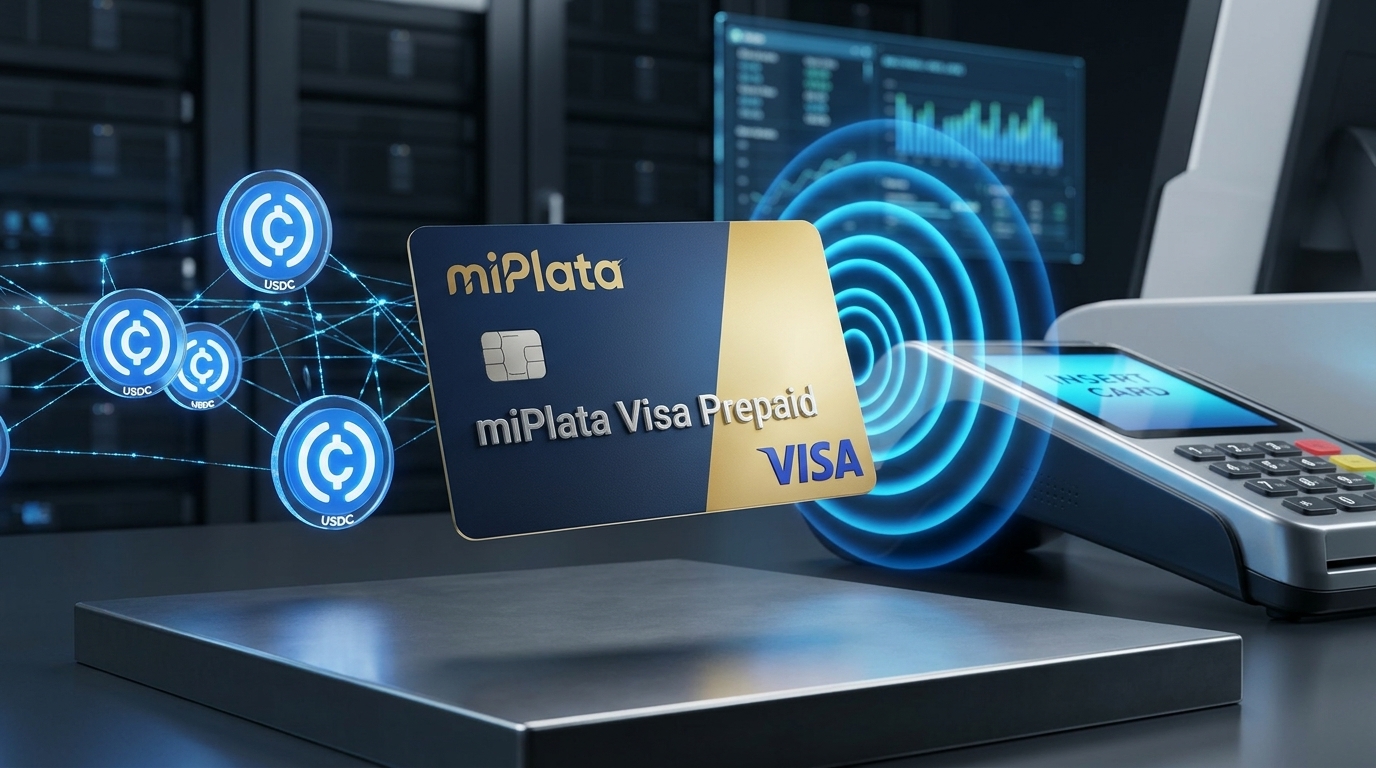
On November 11, 2026, miPlata announced the launch of a physical Visa prepaid card that allows eligible users to spend from stablecoin balances held in their miPlata accounts. The card was developed using Stripe Issuing infrastructure, with Lead Bank responsible for issuing it and Bridge Ventures LLC serving as programme manager.
This arrangement brings together several companies with different responsibilities. miPlata provides the customer-facing application, Stripe supplies the card-issuing infrastructure, Bridge manages the card programme, and Lead Bank acts as the issuing bank.
The central idea is to reduce the steps between holding digital dollars and using them for everyday purchases.
Previously, someone holding USDC might have needed to move the stablecoin to an exchange, convert it into fiat currency, withdraw the proceeds and then fund a payment card or bank account. A stablecoin-linked card can simplify that process by connecting the user’s digital asset balance to a familiar payment method.
According to the Lead Bank prepaid cardholder agreement, when a card transaction is initiated and authorised, the associated stablecoins are sold, and the fiat proceeds are loaded onto the card. This means the merchant receives a conventional card payment rather than receiving USDC directly.
The distinction matters because spending from a stablecoin balance is not necessarily the same as settling a merchant payment on a blockchain. For users, the experience can still feel straightforward: they hold digital dollars and use a Visa card to make purchases. Behind that experience, however, financial institutions and payment infrastructure handle the conversion and card transaction.
The cardholder agreement also states that the issuing bank does not handle the movement, custody, purchase or sale of the stablecoins associated with the card. Those activities fall under separate arrangements involving the platform provider and programme manager.
Where blockchain fits into the payment experience
Stablecoins are blockchain-based assets, but the presence of USDC in a financial application does not automatically mean every part of its payment process happens on-chain.
In miPlata’s case, blockchain technology is relevant to how USDC exists and moves as a digital asset. USDC is issued on supported blockchain networks, where transactions can be recorded and verified.
However, the company’s public product information does not clearly identify which blockchain network it uses for customers’ USDC balances or provide a detailed explanation of its wallet architecture.
That information matters because USDC operates across several networks, including Ethereum, Solana, Stellar, Base and others. Each network has different transaction characteristics, costs and infrastructure requirements.
The card programme also involves conventional financial infrastructure. Lead Bank issues the prepaid card, while Bridge and Stripe support the programme’s operation. The merchant payment itself follows the Visa card network rather than requiring the merchant to accept USDC.
This illustrates how blockchain-based assets can connect with established payment systems without replacing them entirely.
It also raises an important question about transparency: users should understand where their stablecoins are held, how transactions are processed, what happens when they spend and which parties are responsible for protecting their funds.
Connecting financial services across borders
The company offers transfers between miPlata users and international remittance services designed to help customers move money between the United States and selected Latin American markets.
Its website currently identifies Mexico and Colombia as destinations for transfers to external bank accounts, while its account eligibility information covers a wider group of countries, including Guatemala, Honduras, El Salvador, Argentina, Bolivia, Costa Rica, the Dominican Republic, Ecuador, Panama, Peru, Paraguay and Uruguay.
These are two different types of coverage. Being eligible to open an account does not necessarily mean a user can send money to a bank account in every listed country.
The company also advertises free transfers between miPlata users, with the ability to move dollars between accounts in different locations.
For migrant workers and families supporting relatives abroad, this could provide a more convenient way to manage money across borders. Users can receive funds, transfer digital dollars to other miPlata customers and access their balances through supported payment channels.
Still, the actual cost of sending money depends on the transfer amount, payment method and exchange rate. miPlata says it displays applicable fees before customers confirm transactions.
That transparency is important because the cost of a remittance is not determined by the transfer fee alone. Exchange-rate margins and charges from other financial providers can affect how much the recipient eventually receives.
The companies behind the infrastructure
miPlata’s approach relies on partnerships with companies operating different parts of the financial technology stack.
Lead Bank provides the banking infrastructure for its prepaid Visa card. Bridge Ventures LLC manages the card programme, while Stripe Issuing provides the technology used to develop and operate the card programme.
The partnership structure is worth examining because it demonstrates that stablecoin-based financial products do not necessarily need to build every component themselves.
Instead, companies can combine blockchain assets with existing banking, card issuance and payment infrastructure.
In March 2026, Visa and Bridge announced an expanded collaboration to bring stablecoin-linked card programmes to more markets. The announcement explained that Bridge-enabled cards could support on-chain settlement between participating financial institutions and Visa through supported blockchain networks.
However, this broader Visa and Bridge initiative should not be confused with confirmation that every miPlata card transaction settles on-chain. The cardholder agreement describes the conversion of stablecoins into fiat proceeds for card spending.
miPlata also says it is SOC 2 certified. SOC 2 is an independent auditing framework used to assess how service providers manage areas such as security, availability and customer data. It is not a banking licence or a guarantee that every financial risk has been eliminated.
The company’s reliance on established partners may help it bring financial products to market, but users still need clear information about how their assets are protected and which institution is responsible for each service.
What miPlata still needs to demonstrate
miPlata is building around a practical idea: people should be able to receive, hold, transfer and spend digital dollars without having to understand every technical layer behind the process.
Its USDC-linked Visa card is a step towards making stablecoins more usable outside cryptocurrency exchanges and specialised wallet applications.
However, several questions remain important when assessing the platform.
First, the company needs to provide more clarity about the blockchain networks supporting its USDC balances and how those assets are held. Its public-facing website does not explain these technical arrangements in sufficient detail.
Second, users need to understand the full cost of using the service. Although miPlata advertises free transfers between its users, international transfers and card-related transactions may involve other charges, exchange-rate differences or restrictions.
Third, geographical availability matters. The company lists several countries for account eligibility, but the availability of specific transfer corridors and payment services varies.
Finally, there is the question of customer protection. miPlata’s cardholder agreement explains that the prepaid card is issued by Lead Bank, but also states that card funds are not FDIC-insured. Users should understand the difference between protections attached to a bank-issued payment card and the risks associated with holding stablecoins.
These details will influence whether customers view miPlata as a dependable place to manage their money.
Making digital dollars more practical
miPlata’s approach reflects a broader shift in the crypto industry. Rather than asking users to learn how cryptocurrency exchanges and blockchain wallets work, companies are increasingly bringing digital assets into financial products people already understand.
Its combination of digital dollar accounts, remittances and a stablecoin-linked Visa card shows how USDC can become part of an everyday payment experience.
The blockchain component provides the infrastructure for digital dollar transfers, while banking and card partners connect those assets to conventional payment systems.
There is still a difference between making stablecoins available and proving that they deliver better financial outcomes. Transaction costs, exchange rates, asset protection, local availability and customer support will determine whether the product offers a meaningful advantage.
For miPlata, the opportunity lies in making digital dollars easier to access and spend. Its challenge is to build the trust, transparency and reliable financial infrastructure needed to turn that proposition into a lasting service.