
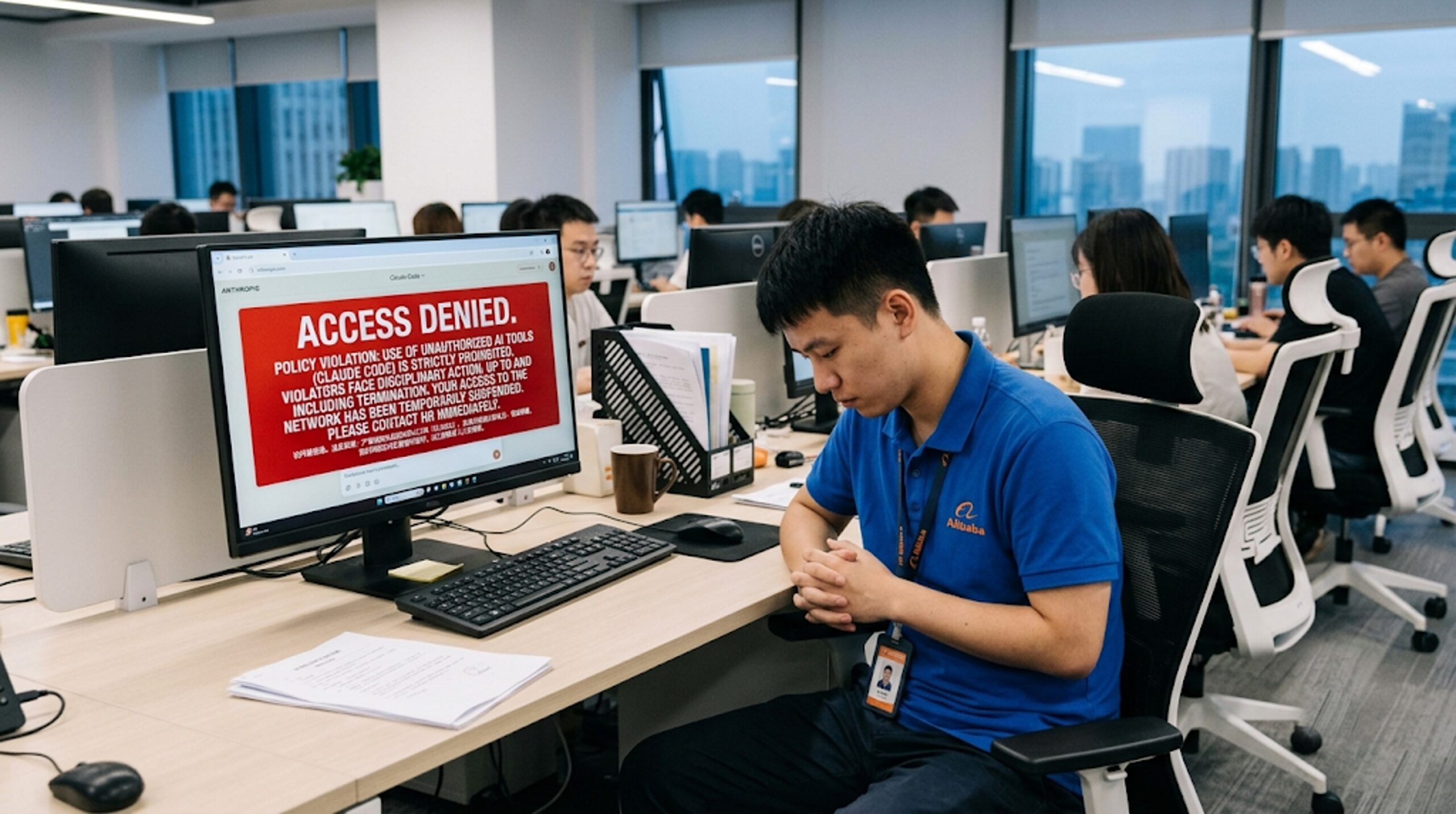
Alibaba has instructed its employees to stop using Anthropic’s AI coding assistant, Claude Code, for work over concerns about an alleged backdoor in the software, marking the latest flashpoint in the growing AI rivalry between the U.S. and China.
The internal ban will take effect on July 10, with employees expected to switch to Alibaba’s in-house AI coding assistant, Qoder. The decision follows an internal review that reportedly raised concerns about how Claude Code interacts with users’ devices and communicates with Anthropic’s servers.
Claude Code is Anthropic’s AI-powered coding assistant built to help developers write, review and debug software. Since its launch, the tool has gained popularity among software engineers for its ability to understand large codebases, generate code and assist with complex programming tasks.
However, security researchers recently discovered that the tool collects certain details from a user’s environment, including timezone and proxy-related information, while embedding hidden identifiers in requests sent back to Anthropic. The findings triggered concerns that the behaviour could present security and privacy risks in corporate environments.
Anthropic has rejected suggestions that the feature was designed as a backdoor. According to the company, it was introduced earlier this year as an experimental safeguard to detect account abuse, prevent unauthorised access and combat AI model distillation, a technique where developers use the outputs of one AI model to train another competing model. Anthropic said it has since developed alternative protections and plans to remove the feature.
The dispute comes just weeks after Anthropic accused parties linked to Alibaba of attempting to extract knowledge from its Claude models through large-scale model distillation. The company claimed the operation involved the creation of numerous accounts that generated millions of prompts in an effort to improve competing AI systems. Alibaba has not publicly responded to those allegations.
The latest decision reflects growing concerns among technology companies over the security of AI tools used in the workplace. As coding assistants become part of everyday software development, businesses are paying closer attention to how these tools handle sensitive information, communicate with external servers and process proprietary source code.
The move also underscores the increasingly tense relationship between U.S. and Chinese AI companies. As competition intensifies, companies are not only racing to build more capable AI models but are also taking stronger measures to protect their technology from unauthorised use, model copying and potential security threats.
For Anthropic, the latest development adds to a series of recent challenges. The company recently dealt with temporary U.S. export restrictions on its newly launched Claude Fable 5 models before access was restored after additional cybersecurity safeguards were introduced. While that issue was unrelated to Alibaba’s decision, both incidents highlight the growing scrutiny facing frontier AI models as governments and companies seek to balance innovation with security.
Alibaba’s decision is unlikely to affect Claude Code’s availability outside the company. However, it serves as another reminder that enterprise adoption of AI tools is increasingly being shaped not only by performance, but also by trust, transparency and security.