
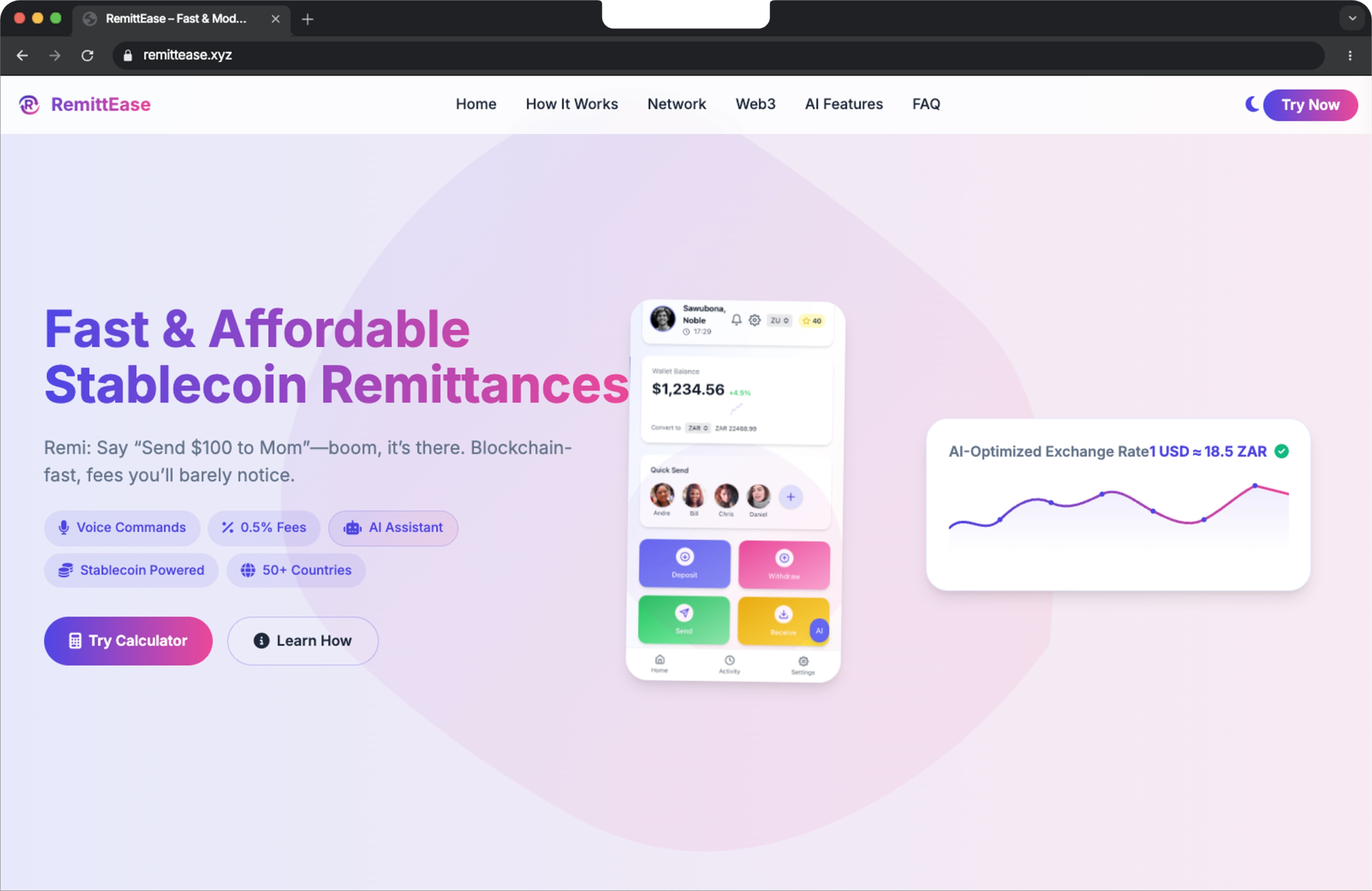
“Send $100 to Mom.” It is the kind of instruction that should be simple, yet sending money across borders can involve currency conversion, transfer fees, payment providers and delays. RemittEase wants to make that process feel more like a conversation than a financial transaction, using artificial intelligence, stablecoins and blockchain infrastructure to move money between countries.
The remittance platform combines voice commands with stablecoin-powered transfers, aiming to make international payments easier to initiate and less expensive to complete. Its approach puts two technologies at the centre of the experience: AI interprets what the user wants to do, while blockchain infrastructure is intended to facilitate the movement of digital value.
For African markets, where families, freelancers and businesses often need to move money between countries, the proposition is worth examining. But the real test is not how easily a user can request a transfer. It is whether the platform can deliver that transfer affordably, reliably and through accessible local payment channels.
Turning a spoken request into a money transfer
RemittEase’s main selling point is its voice-first interface. Rather than navigating several screens to enter a recipient’s details and specify a transfer amount, users are meant to issue a natural-language command, such as “Send $100 to Mom.”
The process begins with account setup and voice training. Users can add trusted contacts and establish spending limits for voice-initiated transfers. They can then speak their request, allowing the AI assistant to interpret the intended recipient, amount and destination.
The system is designed to confirm the transfer details, convert the user’s money into stablecoins, identify a suitable transaction route and execute the transfer. RemittEase also advertises voice biometrics, additional verification for larger transactions and multilingual support.
The idea is to reduce the steps between deciding to send money and initiating the payment. That could be useful for people who find conventional payment interfaces cumbersome, as well as users who regularly send money to the same recipients.
However, voice recognition introduces its own risks. A system must correctly identify the recipient, amount and currency before moving funds. Misheard instructions, similar contact names and fraudulent voice impersonation can create opportunities for costly mistakes. Biometric checks and transaction confirmations may reduce these risks, but the company’s public materials do not independently establish how well these safeguards perform in practice.
The distinction matters because a convenient payment interface is only valuable when it is also dependable.
Why stablecoins are central to the model
RemittEase’s proposed payment process relies on stablecoins, which are digital assets designed to maintain a relatively stable value against another asset, commonly the US dollar.
Stablecoins can move across supported blockchain networks without every transfer requiring a conventional international bank wire. A remittance platform can use them as an intermediate settlement asset, converting a sender’s funds into a stablecoin before arranging the recipient’s payout in a local currency.
For example, a person sending money from South Africa to Nigeria might fund a transfer in rand, have the value converted into a dollar-linked stablecoin, and arrange for the recipient to receive naira. The stablecoin would provide the digital settlement layer between the two sides of the transaction.
This is an illustration of the model, not confirmation that every step of that particular corridor is currently available through RemittEase.
The potential advantage is that blockchain settlement can reduce dependence on some of the correspondent banking arrangements used for international transfers. Depending on the network, liquidity, conversion providers and payout partners involved, this can help reduce settlement time or transaction costs.
But stablecoins do not eliminate the entire payment process. Users may still depend on local banks, exchanges, liquidity providers and other intermediaries to move between traditional currencies and digital assets. Foreign exchange spreads, network fees and payout charges can also affect the final amount received.
For African users, the relevant question is therefore not simply whether a platform uses stablecoins. It is whether its complete transfer process delivers a better outcome than the alternatives available in the same market.
Where blockchain fits into the payment process
Blockchain is the infrastructure that records transactions and enables supported digital assets to move between addresses. In a remittance service, it can provide a settlement layer for transferring stablecoins across borders.
RemittEase’s blockchain-powered system is designed to support fast transfers, verifiable transaction records and a multi-currency wallet. The company also advertises an optional self-custody wallet, which would allow users to retain control of their digital assets rather than relying entirely on a service provider to hold them.
Self-custody is an important distinction. In a custodial arrangement, a provider controls the private keys associated with a user’s assets. In a self-custodial wallet, the user controls the keys or recovery mechanism. The latter offers more direct control, but it also places greater responsibility on the user to protect access to the wallet.
The company also describes a decentralised network with validators and says its architecture is designed to limit the storage of sensitive information in a central database. These are significant technical claims, but the public-facing materials reviewed for this article do not clearly identify the full network configuration, provide a detailed architecture, or independently establish how user data and transaction authorisation are handled.
The Stellar Community Fund provides an external connection between RemittEase and blockchain infrastructure. Its project directory identifies RemittEase as a Stellar-powered remittance project and lists an award of approximately $54,100 for an initiative focused on launching in South Africa and Nigeria.
That award provides evidence of ecosystem support for the project. It does not, by itself, confirm that all the advertised features are live, that every transfer settles on Stellar, or that the platform has achieved its stated transaction volumes.
For a service handling money, those distinctions are essential. Users and potential partners need to understand which network processes a transfer, how assets are held, what happens if a transaction fails and who is responsible for resolving disputes.
Can AI make remittances cheaper?
RemittEase advertises a transfer fee of 0.5%. Its website calculator compares that rate with a hypothetical traditional transfer fee of 6%, presenting a $55 saving on a $1,000 transfer.0.5% of $1,000 is $5, while 6% is $60. But the comparison is illustrative, not proof that every RemittEase transfer costs 0.5% in total or that every competing service charges 6%.
The actual cost of sending money depends on the sending and receiving countries, the currencies involved, exchange-rate margins, funding methods and payout arrangements. A low advertised transfer fee can still be accompanied by other costs if the exchange rate is less favourable or an intermediary charges separately.
AI could help by interpreting user instructions, comparing available conversion routes and reducing the manual work involved in initiating a transfer. Yet AI does not automatically make the underlying transaction cheaper. The final cost depends on the liquidity providers, blockchain network, currency conversion and payout infrastructure available for that corridor.
RemittEase’s value proposition will be stronger if it can show users the full cost before they confirm a payment, including the exchange rate, any additional charges and the exact amount the recipient will receive.
Why it is Important for the African market
Remittances are an important part of the financial relationship between African countries and their diaspora communities. People send money to support relatives, pay education and medical expenses, cover household needs and fund businesses. Freelancers and small companies also need practical ways to receive payments from international clients and suppliers.
The region is not a single payment market, however. Each country has its own financial institutions, currency controls, payment methods and regulatory requirements. A service that works in one corridor may not offer the same experience in another.
RemittEase lists currencies including the Nigerian naira, Kenyan shilling and South African rand, alongside major international currencies. Its Stellar Community Fund listing also identifies South Africa and Nigeria as the focus of a funded launch initiative.
These details provide a starting point for understanding the company’s intended market. They should not be interpreted as proof that every listed currency can currently be used for both sending and receiving money, or that the service has operational coverage across all advertised countries.
The quality of local payout arrangements will be particularly important. A blockchain transaction may settle quickly, but a recipient still needs a practical way to access and use the funds. If the final step requires a difficult conversion or an unavailable payment channel, the benefits of faster digital settlement can be reduced.
What RemittEase still needs to demonstrate
RemittEase presents an ambitious combination of voice-driven payments, stablecoins and blockchain settlement. Its approach is designed to hide much of the technical complexity from users, allowing them to focus on who they want to pay and how much they want to send.
However, its website makes several substantial claims about scale and performance. These include support for more than 50 countries, millions of users, hundreds of millions of dollars in monthly volume, transfer completion in seconds and significant savings on fees.
The public materials reviewed for this article do not provide sufficient independent evidence to verify those figures. The website’s claims should therefore be treated as company-reported information, not established adoption or performance metrics.
Several questions remain important before the platform’s full value can be assessed:
- Which blockchain networks and stablecoins are currently supported?
- Which sending and receiving corridors are live, and what local payout methods are available?
- Does the advertised 0.5% fee include foreign exchange spreads, network costs and payout charges?
- How are customer funds held, and which transactions use self-custody?
- What security audits, regulatory authorisations and operational safeguards support the service?
- Can the company provide independently verifiable information on transaction volume, completion times and active users?
These are not minor details. They determine whether the platform can move beyond a compelling concept to become a reliable financial service.
Making cross-border payments simpler
RemittEase is pursuing a practical problem: international money transfers can be costly, fragmented and difficult to navigate. Its proposed combination of voice commands, AI-assisted routing and stablecoin settlement offers one way to simplify the experience.
The blockchain component could help move digital value between countries, while AI could make the process easier to initiate. But neither technology removes the need for reliable currency conversion, accessible payout channels, strong security and compliance with the rules governing money transfers.
The company’s connection to the Stellar ecosystem and its funding for a South Africa and Nigeria initiative provide useful evidence of its development path. Its next challenge is to establish the extent to which the service is operating as described and whether users can consistently achieve the advertised cost and speed advantages.