
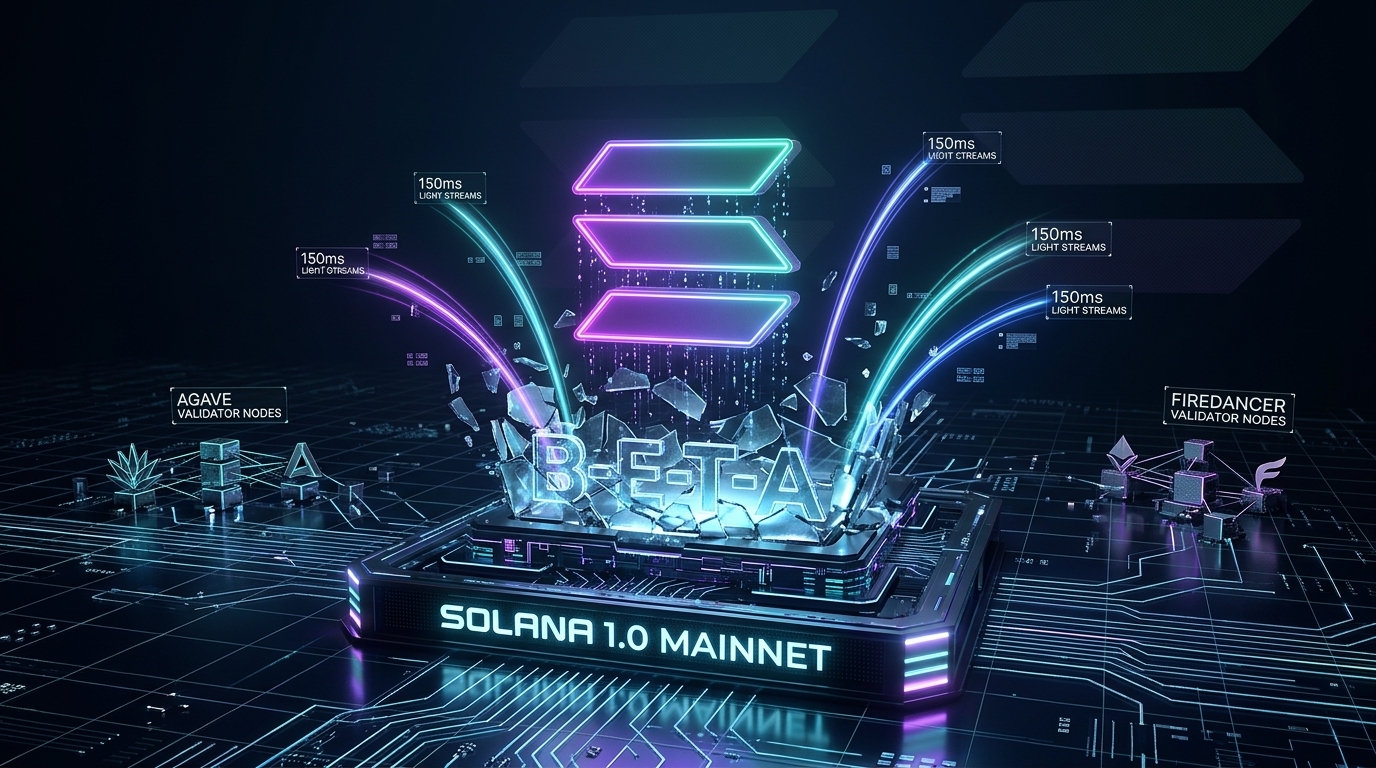
Solana has officially retired the “mainnet beta” label it has carried since its launch in 2020, introducing Solana 1.0 as the network moves to a formal mainnet designation.
The Solana Foundation announced the change, describing it as a milestone that reflects the network’s progress in performance, reliability and infrastructure.
However, the transition does not involve a new blockchain or a major network migration. Existing SOL tokens, user accounts, digital assets, decentralised applications and transaction histories remain unchanged.
Users do not need to update their wallets or take any action to continue using the network.
Why Solana is dropping the beta label
Solana has operated as a live production blockchain since its mainnet beta launch in March 2020. Despite supporting millions of transactions and a growing ecosystem of decentralised applications, the network retained the beta designation.
According to the Solana Foundation, removing the label recognises the network’s development and establishes a clearer system for tracking protocol upgrades.
The introduction of Solana 1.0 also creates a shared version number for the network’s underlying protocol, separate from the software versions used by individual validator clients.
This distinction is important because Solana has multiple validator clients, including Agave and Firedancer, which have separate codebases and release schedules.
With a shared protocol version, developers and network operators can identify which protocol changes different software releases support without confusing a validator client’s version number with the network’s overall version.
Alpenglow and Firedancer support the transition
The Solana Foundation pointed to improvements in network performance and infrastructure as part of the reason for retiring the beta designation.
One major development is Alpenglow, a consensus upgrade activated on Solana’s mainnet. The upgrade changes how validators reach agreement and is designed to reduce transaction finality to approximately 150 milliseconds.
Transaction finality refers to the point at which a transaction is considered settled and irreversible under the network’s consensus rules.
Another development is Firedancer, an independently developed validator client designed to provide an alternative to Agave.
Having multiple independently developed clients reduces the network’s reliance on a single software implementation. It can also improve resilience by limiting the risk that a bug affecting one client will disrupt the entire network.
Together, these developments represent progress in Solana’s infrastructure and its ability to support a growing blockchain ecosystem.
What Solana 1.0 means for users and developers
The change is largely a naming update. SOL balances, wallet addresses, applications and transaction records remain the same. Developers and infrastructure operators, however, will need to pay attention to protocol compatibility and software release instructions as future upgrades are introduced.
The Foundation also clarified that introducing Solana 1.0 does not automatically activate every upcoming network improvement. Individual features will continue to follow their own deployment schedules and activation requirements.
Solana’s documentation, blockchain explorers and other ecosystem platforms will gradually adopt the new mainnet designation.
The removal of the beta label marks a new chapter for Solana, but it does not mean development has stopped. Instead, the network is establishing a clearer foundation for future upgrades as it expands its validator ecosystem and competes for developers, users and applications across the blockchain industry.
Read also: US to seize $1.2B in crypto stolen from Binance by North Korea