
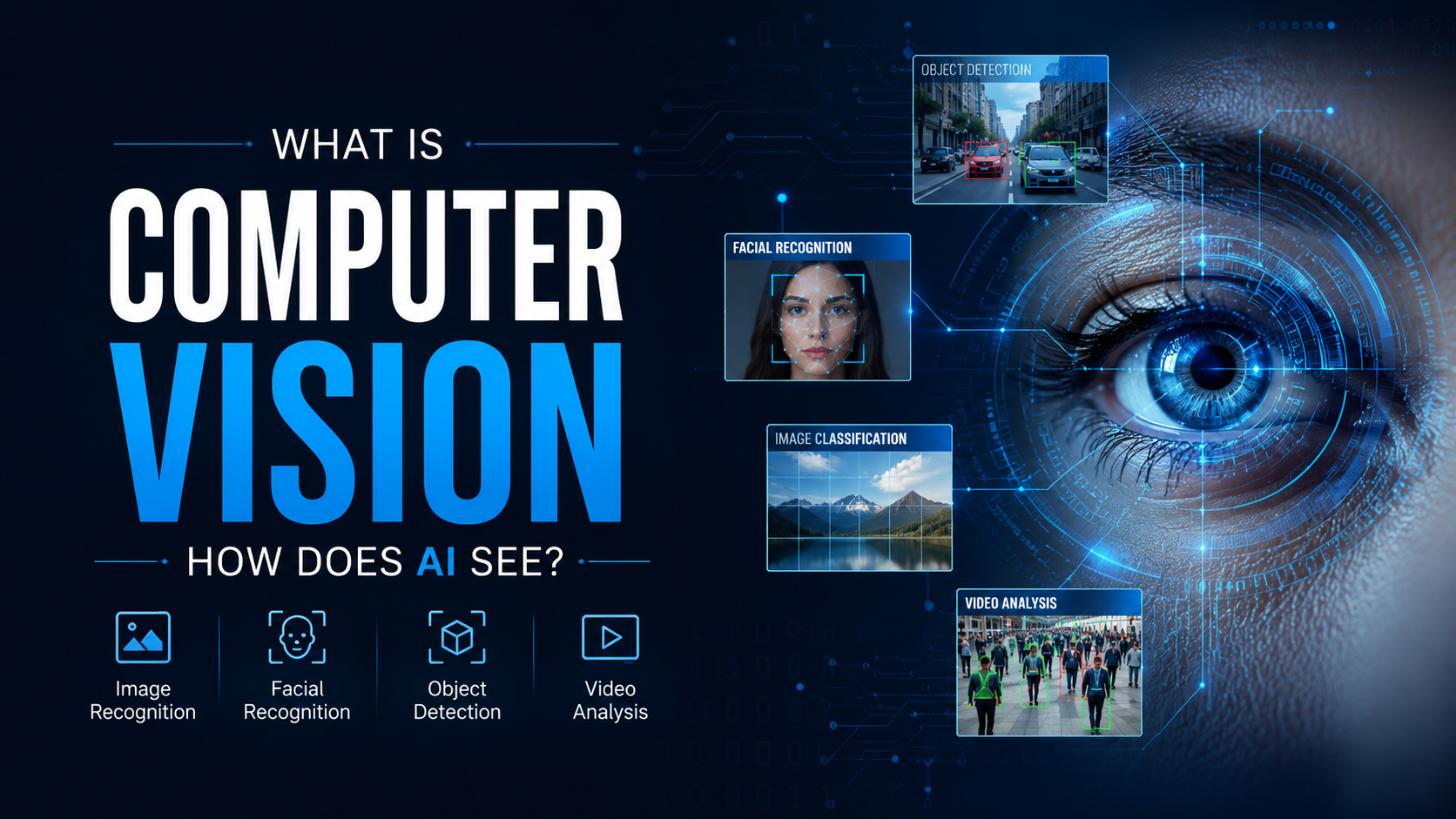
Computer vision is the branch of artificial intelligence that gives machines the ability to process, analyse, and interpret visual information from the world, including images, video, and other forms of visual data.
Your phone unlocks the moment it sees your face. A self-driving car stops at a red light without anyone touching the brakes. A hospital scanner flags a tumour in an X-ray before a doctor has finished reviewing the image. None of these moments happens by accident, and none of them involves a human making the call in real time. They all rely on one of the most powerful and practically significant branches of artificial intelligence in existence today: computer vision.
Most people have encountered computer vision dozens of times this week without thinking about it. The filter that places digital sunglasses on your face in a social media app is computer vision. The security camera that detects an intruder on a property is computer vision. The supermarket checkout that scans and identifies your items automatically is computer vision. The question most people have never stopped to ask is a simple one: how does a machine actually see? What is happening inside an AI system when it looks at an image and understands what it contains? This article answers that question, plainly and clearly.
Teaching a Machine to See
Seeing feels effortless to humans. A child can look at a photograph and instantly identify a dog, a tree, a car, or a person without any conscious effort. The brain processes visual information so fast and so automatically that it is easy to take for granted. But the simplicity of human vision is deceptive. It is the product of millions of years of biological evolution and years of personal learning accumulated from birth. Teaching a machine to replicate that ability is one of the most technically demanding challenges in the history of computing.
The reason it is so difficult starts with how computers represent images. To a machine, an image is not a picture. It is a grid of numbers. Every pixel in a digital image has a numerical value that represents its colour, typically a combination of red, green, and blue values ranging from zero to two hundred and fifty-five. A standard photograph contains millions of these numbers, and by themselves, those numbers carry no meaning. They are just data. The challenge of computer vision is turning that raw numerical data into understanding, teaching a system to look at millions of numbers and conclude that what they represent is a dog sitting next to a tree in a park.
What Computer Vision Actually Is
AI uses machine learning and deep learning to enable systems to extract meaningful information from what they see and make decisions or produce outputs based on that information. The field covers a wide range of tasks. Image classification involves assigning a label to an entire image, determining that a photograph contains a cat, a car, or a piece of fruit.
Object detection goes further, identifying not just what is in an image but where it is, drawing a boundary around each object and labelling it. Image segmentation breaks the image down at the pixel level, assigning every pixel to a specific category or object. Facial recognition identifies specific individuals by comparing the features of a face against a stored reference. Optical character recognition reads and converts printed or handwritten text in images into digital text that can be processed further. Each of these tasks represents a different application of the same underlying capability: making sense of visual data the way a human would.
The Process Explained: How AI Sees
When a computer vision system processes an image, it does not see it the way a human does. It runs the image through a series of computational layers, each one extracting a different level of information, until it arrives at a high-level understanding of what the image contains.
The technology at the heart of most modern computer vision systems is the convolutional neural network, a type of deep learning architecture specifically designed to process visual data. A convolutional neural network works by passing a set of small filters across the image, where each filter is trained to detect a specific low-level visual feature: a horizontal edge, a vertical line, a particular texture, or a change in contrast. The output of these filters is a set of feature maps that represent which parts of the image contain which low-level patterns.
In deeper layers of the network, these low-level features are combined into higher-level patterns. Edges become shapes. Shapes become structures. Structures become recognisable objects. By the time information reaches the final layers of the network, the system has built up a rich, hierarchical representation of the image, moving from raw pixel values all the way to a conclusion like “this is a face” or “this image contains a vehicle” or “this X-ray shows an abnormality in the upper left quadrant.”
More recently, a new type of architecture called the vision transformer has emerged and is rapidly becoming the approach of choice for many computer vision tasks. Rather than processing images by sliding filters across them, vision transformers divide the image into a grid of small patches and process those patches the same way a language model processes words, using attention mechanisms to understand the relationships between different parts of the image. Models like OpenAI’s CLIP and Google’s ViT are built on this approach and represent some of the most capable visual AI systems available today.
Where Computer Vision Is Already Being Used
The applications of computer vision in 2026 span almost every major industry, and the scope of what it can do has expanded significantly as the underlying models have grown more capable.
In healthcare, computer vision systems are being used to analyse medical images including X-rays, MRI scans, and CT scans with a level of accuracy that matches or exceeds specialist physicians in specific diagnostic tasks. These systems can detect early signs of diseases like cancer, diabetic retinopathy, and cardiovascular conditions from visual data, enabling earlier intervention and improving patient outcomes at scale.
In manufacturing, computer vision is used for quality control, automatically inspecting products on assembly lines for defects, deformities, or inconsistencies that would be difficult for a human inspector to catch consistently over a long shift. The speed and accuracy of these systems make them more reliable than manual inspection for high-volume production environments.
In retail, computer vision powers automated checkout systems that identify products without barcodes, track inventory levels by analysing shelf images, and monitor foot traffic patterns inside stores. These capabilities reduce operational costs and improve the customer experience by removing friction from the shopping process.
In transportation, computer vision is the sensory foundation of autonomous vehicle systems. Self-driving cars rely on computer vision to detect other vehicles, pedestrians, road signs, lane markings, traffic signals, and obstacles in real time. The safety of autonomous driving depends entirely on the accuracy and speed of these visual processing systems.
In security and public safety, computer vision enables surveillance systems to detect unusual behaviour, identify individuals, and alert security personnel to potential threats without requiring constant human monitoring. The same technology is used for border control, access management in secure facilities, and crowd analysis at large events.
The Limits of Machine Vision
For all of its capability, computer vision has genuine limitations that matter in real-world applications. These systems are only as good as the data they were trained on. A model trained primarily on images from one type of environment or demographic may perform poorly when deployed in a different context. A facial recognition system trained on a dataset that underrepresents certain groups will be less accurate for those groups, which is a serious concern in applications where the consequences of error are significant.
Computer vision systems can also be fooled in ways that human vision would not be. Small, carefully designed alterations to an image that are completely invisible to a human observer can cause a deep learning model to misclassify the image entirely. These adversarial examples represent a real security concern in applications where the integrity of visual recognition is critical.
Computer vision also struggles with scenes that fall significantly outside its training distribution. A system trained to detect objects in daylight may perform poorly in low light. A model trained on high-resolution images may struggle with blurry or low-quality input. Understanding these limitations is essential for anyone deploying these systems in environments where reliability matters.
Seeing the Bigger Picture
Computer vision is one of the most tangible and immediately visible applications of artificial intelligence in everyday life. It is already changing how healthcare is delivered, how products are manufactured, how vehicles navigate, and how people interact with their devices. The global market for computer vision technology is projected to exceed eighty billion dollars by 2026, which reflects how broadly and how quickly it is being adopted across industries.
Understanding what computer vision is and how it works does not require a background in deep learning or image processing. It only requires recognising that when a machine looks at an image and understands what it contains, it is doing something that required decades of research to make possible, and something that is now quietly reshaping the world in ways most people interact with every single day.
Read also: What is Prompt Engineering and Why Does It Matter?