
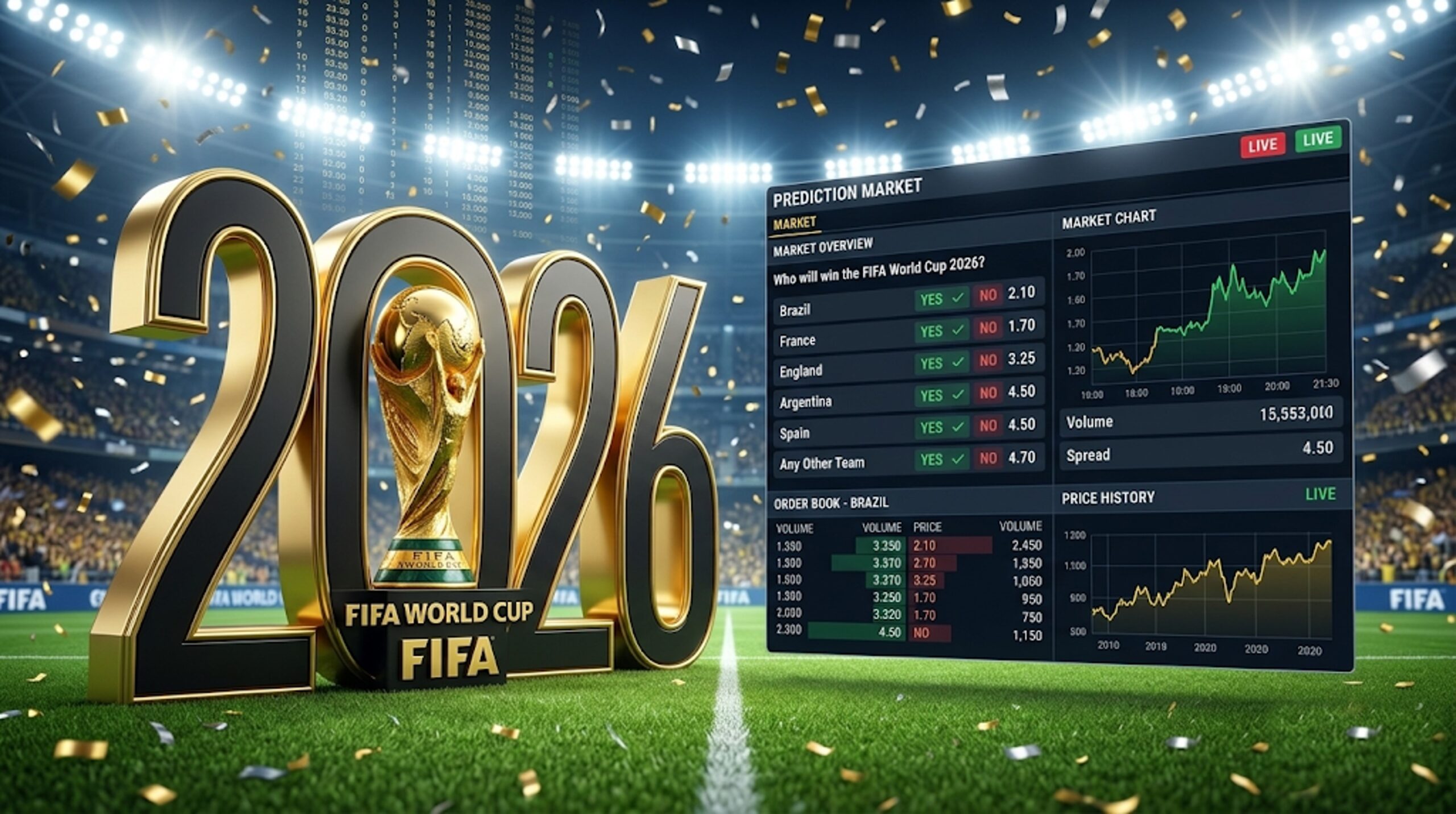
The 2026 FIFA World Cup is still days away, but one contest is already underway.
Beyond the battle for football’s biggest trophy, blockchain-based prediction markets are facing their largest sporting test yet as traders pour billions of dollars into contracts tied to the tournament’s outcome.
Platforms such as Polymarket and Kalshi have seen activity surge ahead of the World Cup, with trading volumes approaching $2 billion across markets linked to match results, tournament winners, top scorers, and team performances.
The growth highlights how prediction markets are evolving from niche crypto products into mainstream alternatives to traditional sports betting.
Unlike conventional sportsbooks, prediction markets function more like financial exchanges. Users buy and sell contracts based on the probability of an event occurring, with prices fluctuating as sentiment changes. A team viewed as more likely to win sees its contract price rise, while confidence in weaker teams pushes prices lower.
Supporters argue that this structure creates a more efficient way to measure public expectations. Critics, meanwhile, say prediction markets often blur the line between forecasting tools and gambling products.
The World Cup presents a major opportunity for the sector.
The tournament is expected to attract billions of viewers worldwide and generate enormous wagering activity across licensed betting platforms. Prediction market operators hope the event will introduce a broader audience to a model that has gained traction through elections, economic forecasts, and cryptocurrency-related events.
Current market data places Spain, France, Brazil, Argentina, England, and Portugal among the leading contenders to lift the trophy, reflecting how traders are assessing the competition ahead of kickoff.
The timing is significant. Regulatory scrutiny of prediction markets has intensified over the past year as authorities seek to determine whether these platforms should be regulated as financial exchanges, betting operators, or something entirely different.
For the crypto industry, the World Cup is becoming more than a sporting event. It is a global showcase for a rapidly growing sector that wants to prove prediction markets can be more than speculative experiments.
Whether they succeed may depend as much on market performance as the football itself.
Read also: Nigerian Senate advances bill to regulate crypto operators