
Cross-border payments can take more than a simple transfer between two accounts. Businesses sending money between Africa and Europe often have to deal with currency conversion, banking intermediaries, compliance checks and delays before funds reach the recipient. For companies making regular international payments, these challenges can increase costs and make it harder to manage cash flow.
Stablecoins offer another way to transfer value between countries. Instead of relying entirely on traditional banking networks, businesses can use digital assets such as USDC and USDT to move money across supported blockchain networks. However, the recipient may still need the funds in a local bank account or a currency used to pay suppliers and employees. This creates a need for payment services that can connect blockchain transactions with local financial systems.
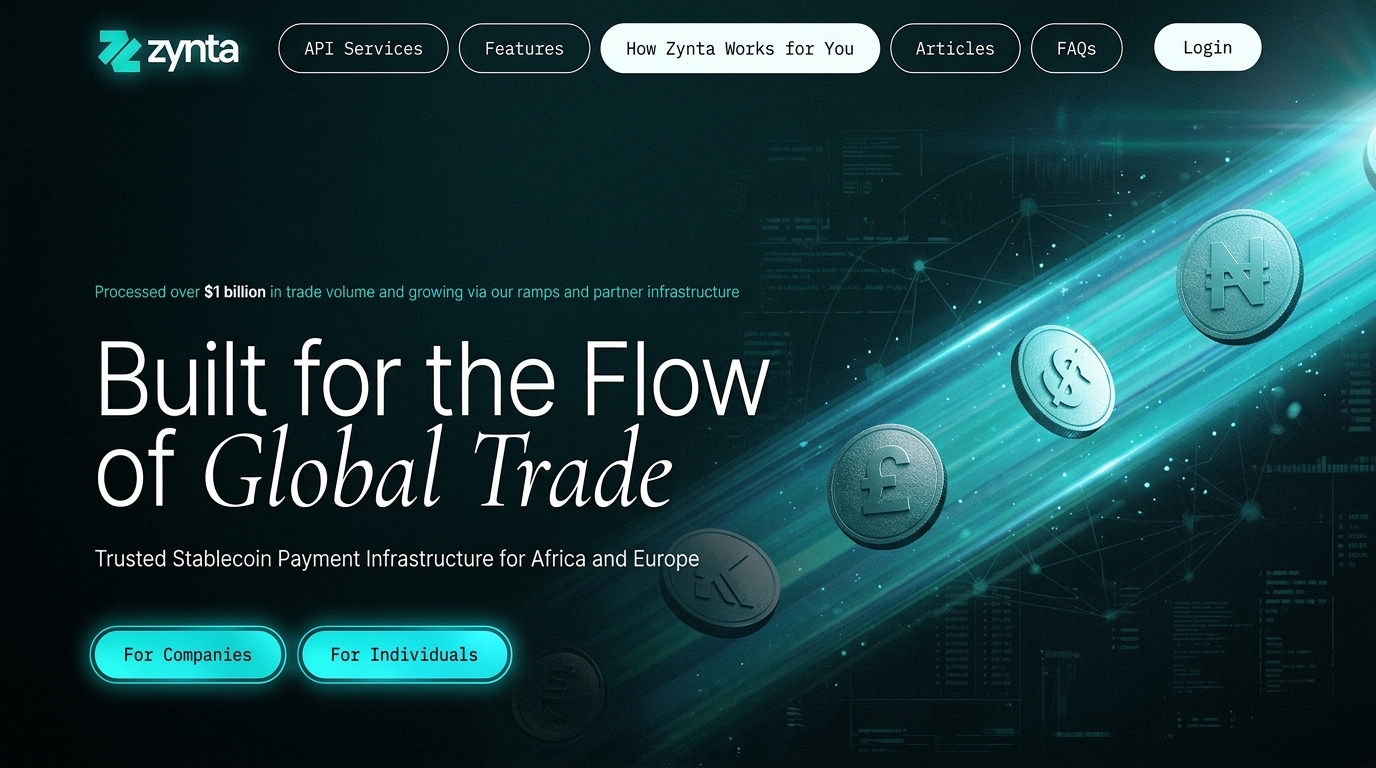
Zynta is building infrastructure to address this problem, with a focus on cross-border payments between Africa and Europe. The platform connects stablecoin liquidity to local payment networks, allowing businesses to transfer value internationally and deliver funds through supported payment channels. Its services include currency conversion, virtual accounts, compliance tools and APIs that other financial companies can integrate into their products.
What Zynta Does?
Zynta is a cross-border payment platform designed for businesses, fintech companies, trading firms and individuals who need to send, receive or convert money across countries. It uses stablecoin technology to facilitate transfers between digital assets and traditional currencies, while handling parts of the payment process that would otherwise require separate providers.
The platform serves both direct users and businesses that need payment infrastructure. Individuals can use its wallet and transfer services to send money internationally, exchange currencies and withdraw funds through supported channels. Businesses can use Zynta’s API to access cross-border settlements, virtual accounts, foreign exchange services and compliance tools within their own applications.
This distinction is important because Zynta is not simply a wallet for holding digital assets. It also provides the infrastructure that allows other companies to offer international payment services without building every banking connection and stablecoin integration themselves.
How Zynta Works
Zynta’s payment process connects the sender, the stablecoin or currency used for settlement, and the financial network that delivers the money to the recipient.
A business can initiate a payment through Zynta’s services or integrate its API into an existing application. Depending on the transaction, the platform can coordinate currency conversion, stablecoin settlement and the final transfer through a supported local payment channel. Its infrastructure is designed to reduce reliance on traditional correspondent banking arrangements for the underlying movement of value.
Zynta’s infrastructure can support the conversion and settlement process between those currencies, subject to the available payment route and liquidity.The business does not necessarily need to manage the underlying blockchain transaction itself. Zynta handles the payment infrastructure, while its banking and payment partners support delivery through local financial systems.
However, the speed of a blockchain transaction does not guarantee that every international payment will arrive instantly. The final delivery time can depend on compliance checks, liquidity, banking hours and the receiving institution. Zynta advertises real-time settlement for supported routes, but actual performance will vary by transaction and corridor.
Multi-Currency Virtual Accounts
Zynta provides virtual accounts in several currencies, including the US dollar, euro, British pound and Nigerian naira. Its business API also lists support for the Mexican peso. These accounts allow businesses to collect payments in supported currencies and move funds between fiat and digital assets through the platform.
Virtual accounts are useful for companies that work with customers and suppliers in different countries. A business selling services to European customers, for example, may need to receive euros while paying its operating expenses in naira. Having access to multiple currency accounts can make it easier to manage those transactions without relying on a separate provider for every currency.
Zynta’s virtual accounts also support fiat on-ramps and off-ramps. An on-ramp allows users to move money from traditional currencies into digital assets, while an off-ramp converts digital assets into fiat currency for withdrawal or spending through supported payment channels.
However, the availability of a virtual account does not necessarily mean the customer has a traditional bank account in that country. The account’s functions depend on Zynta’s banking partners and the services available in each market.
Stablecoin Conversion and Foreign Exchange
Currency conversion is an important part of Zynta’s payment infrastructure. International payments often require money to be exchanged before it reaches the recipient, and the exchange rate can affect the final amount received.
Zynta supports fiat-to-fiat, fiat-to-crypto and token conversions through its business API. This allows businesses to exchange supported currencies or move between traditional money and stablecoins within the same payment process. The platform advertises real-time foreign exchange rates and a transfer fee of 0.5% for external transfers. Transfers between Zynta users are listed as free.
The main consideration is the total cost. A transfer fee does not necessarily represent the full expense of moving money across borders. Exchange-rate spreads, liquidity conditions and charges from payment partners can also affect the final amount received.
Stablecoins also introduce risks involving their issuers, reserves and ability to maintain their intended value. Businesses using this infrastructure must consider these factors alongside transaction speed and cost.
APIs for Fintech Companies and Trading Businesses
Zynta’s business API allows other companies to integrate its payment infrastructure into their own products. This is particularly relevant to fintech platforms, neobanks, cryptocurrency exchanges, digital wallets and trading companies that need to move money across borders.
Through a single integration, businesses can access multi-currency payments, virtual accounts, currency conversion, transaction notifications and reconciliation tools. Zynta also provides a sandbox environment, developer documentation and software development kits for Node.js, Python and PHP. These tools allow developers to test their integrations before deploying them in a live environment.
The API also supports webhooks, which send automatic notifications when transaction events occur. This can help a company’s internal system update payment records without requiring staff to check every transaction manually.
For example, a trading company paying suppliers across several markets could integrate Zynta into its existing finance system. The company could initiate payments, receive status updates and reconcile transactions from one system rather than managing separate processes for each payment provider.
This makes Zynta relevant beyond businesses that want to send occasional international transfers. Its infrastructure is also designed for companies that need to build cross-border payment capabilities directly into their products.
However, the benefits depend on the quality of the integration and the availability of the required payment routes. Businesses still need to assess transaction limits, operational support, fees and the regulatory arrangements that apply to their activities.
Connecting Blockchain Networks to Local Payment Systems
Zynta supports fiat and crypto conversion across blockchain networks, including Ethereum, Solana and Stellar. Its platform is designed to let businesses access multiple networks through one integration rather than building separate connections for each blockchain. This approach addresses a challenge for companies operating across different blockchain ecosystems. A payment provider may need to support several stablecoins and networks while ensuring that funds can still reach recipients through local financial systems.
Zynta’s role is to manage the infrastructure between these two environments. The customer or business can use supported digital assets, while the recipient can receive funds through an available bank account or other payment channel.The blockchain is therefore one part of a larger payment process. The final outcome still depends on liquidity, conversion services, banking partners and the availability of local payment networks.
This distinction is important when assessing stablecoin payment products. A blockchain can transfer an asset without a traditional banking intermediary, but converting that asset into local currency and delivering it to a recipient may still require regulated financial institutions.
Compliance and Transaction Security
Cross-border payments require more than the ability to transfer money. Providers must also verify customers, monitor transactions and meet the regulatory requirements of the markets in which they operate.
Zynta business infrastructure includes know-your-customer and know-your-business verification, anti-money-laundering screening and transaction monitoring. These processes help identify customers, assess business relationships and detect transactions that may require further review.
For fintech companies, having access to existing compliance tools can reduce the amount of infrastructure they need to develop independently. However, using a third-party provider does not automatically remove a business’s own regulatory responsibilities.
Zynta describes itself as a licensed Virtual Asset Service Provider and Money Services Business and says it operates across multiple jurisdictions through its own arrangements and licensed partners. The exact licences and permitted activities need to be assessed for the specific service and country involved.
Security is another consideration. Zynta lists measures such as two-factor authentication, one-time password verification, encryption and cold storage among its stated security practices. These measures can help protect accounts and digital assets, but they do not eliminate every risk associated with cyberattacks, fraud or third-party service failures.
Partnerships and Expansion
In September 2026, Zynta announced that it had joined the founding cohort of Plexo, a network designed to coordinate institutional stablecoin clearing. The initiative brings together financial institutions and payment infrastructure providers to make it easier to establish trusted settlement relationships.
The partnership addresses a problem that software alone cannot solve. When a payment provider enters a new market, it may need to identify suitable counterparties, complete due diligence, agree on operating terms and establish compliance procedures. These processes can take time even when the underlying technology supports rapid settlement.
Through Plexo, Zynta says it can access a network of pre-qualified counterparties and reuse compliance information across participating institutions. The company also brings its Africa-focused payment infrastructure and local delivery capabilities to the network.
Zynta’s Market Position
Zynta operates in a growing part of the financial technology sector focused on using stablecoins to facilitate cross-border payments. Its approach differs from that of a traditional remittance provider, which may rely mainly on established banking networks. It also differs from a cryptocurrency exchange, whose primary function is to support the buying and selling of digital assets.
It combines payment processing, currency conversion, virtual accounts and compliance infrastructure. Its business API allows fintech companies and trading firms to use these services without building every component independently.
Zynta has processed more than $1 billion in trade volume through its infrastructure and partners. Its API materials also list more than 165 enterprise clients, settlement in under 30 minutes and a 99.9% uptime service-level agreement. These are company-reported figures and commitments, rather than independently verified measures of performance.Its focus on Africa-Europe payment routes gives the company a clear area of operation. Its long-term position will depend on how well it serves those markets, the competitiveness of its pricing and its ability to maintain reliable payment connections as transaction volumes grow.
The Role Zynta Could Play in Cross-Border Payments
The growth of stablecoins has created new ways to transfer value internationally, but the technology alone does not solve the practical challenges of receiving and spending money. Businesses still need currency conversion, local payment connections, compliance processes and reliable settlement arrangements.
Zynta is focused on this part of the payment process. It connects stablecoin infrastructure with local financial systems and provides APIs that allow businesses to incorporate these services into their own products. Its combination of virtual accounts, currency conversion, transaction monitoring and payment delivery is designed to reduce the work involved in managing international transfers.
The main test will be whether the platform can deliver payments reliably at a competitive cost across the markets it serves. That requires more than fast blockchain transactions. It depends on liquidity, strong financial partnerships, regulatory compliance and the ability to resolve failed or delayed payments.
Zynta’s approach reflects a wider development in digital finance: stablecoins are becoming part of the infrastructure used to move money, rather than remaining limited to trading and crypto-native applications. If the company continues to expand its payment connections and demonstrate consistent performance, it could play a useful role in helping businesses move money between African and European markets. Its value, ultimately, will depend on how well the infrastructure works when real businesses need to pay suppliers, collect revenue and manage their finances across borders.
Read also: Sorted Wallet: Making stablecoins work on mobile phones